SEO vs AEO: What’s the Real Difference in 2026?
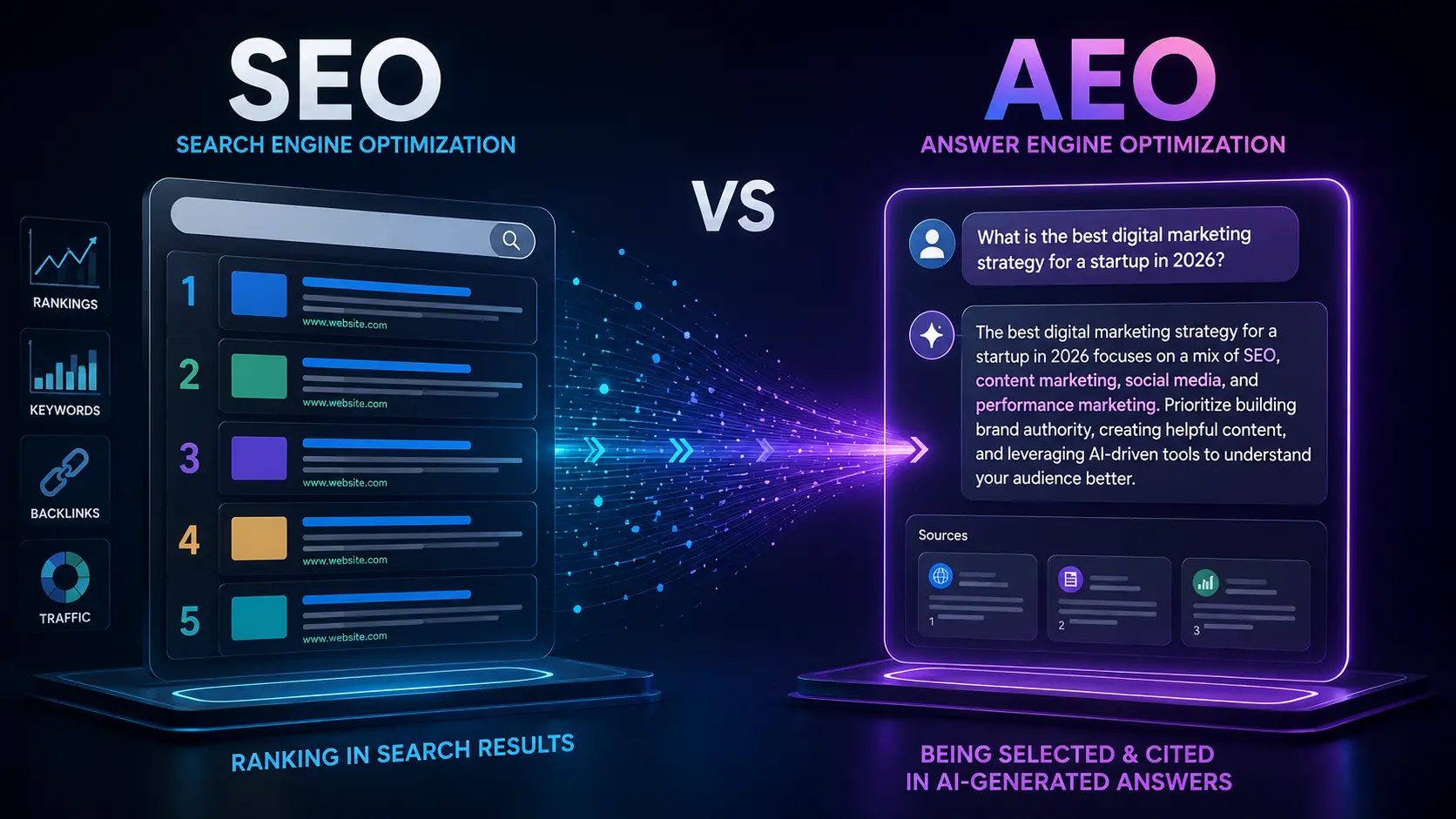
SEO gets your page ranked. AEO gets your answer picked. They’re not competing for the same job, which is exactly why most businesses need to stop treating them as an either-or choice.
If you’ve heard the term AEO floating around this year and wondered whether it’s a real thing or just SEO with a new label slapped on it, you’re not alone. Here’s the short version: it’s real, and it matters, but it’s not a replacement for what you’re already doing.
So What’s Actually Different Here?
SEO is about getting your page to show up and rank well when someone searches on Google. Click the link, land on your site, that’s the whole model. It’s been the game for two decades and it still works.
AEO is about something else. When someone asks a question and gets an answer straight from Google’s AI Overview, or from ChatGPT, Perplexity, or Copilot, without clicking through to anyone’s website, AEO is what determines whether your business gets mentioned as the source of that answer. There’s no click involved at all a lot of the time. You’re not winning a visitor. You’re winning a mention.
That’s a real shift. A growing share of searches now end without anyone clicking a link, because the AI just answered the question directly on the results page. That doesn’t mean SEO stopped mattering. It means there’s a second thing happening now, alongside it, that plays by slightly different rules.
Does AEO Replace SEO, Then?
No, and this is the part that gets oversimplified a lot. AEO actually depends on SEO being solid in the first place. If your site is hard to crawl, your content is vague, your pages load slowly, or your information is outdated, an AI system isn’t going to trust you as a source no matter how well-formatted your answers are. The technical foundation still has to be there.
Think of it this way: SEO builds the house. AEO decides whether someone points to your house specifically when a stranger asks “where’s a good place to live around here.” You need the house to exist and be in decent shape before anyone’s going to recommend it.
What Actually Makes Content AEO-Friendly?
A few things come up consistently:
Answer the question early and clearly. If someone could ask “what is X,” your content should state the answer in plain language near the top of the relevant section, not buried three paragraphs in after a long introduction.
Structure around real questions, not just keywords. Headings phrased as actual questions people ask tend to get pulled into AI answers more often than generic topic labels.
Keep it clean and current. Short paragraphs, clear organization, and information that’s actually up to date matter more here than they used to. AI systems are compressing your content down to its clearest point, and confusing or outdated pages don’t survive that process well.
Add structured data where it fits. FAQ schema and similar markup help both traditional search features and AI systems understand exactly what question your content is answering.
None of this is complicated. It’s mostly just being clear about what you’re saying and making that clarity easy to find and extract.
What Should You Actually Do About It?
Don’t panic and rebuild your whole content strategy around AEO alone. Traditional search still drives the majority of real traffic for most businesses today, and that’s not disappearing overnight. But if you’re only optimizing for clicks and ignoring citations, you’re leaving visibility on the table in exactly the place your customers are increasingly starting their research.
The practical move is layering AEO habits on top of the SEO work you’re already doing, rather than picking one over the other. If you’ve read the practical guide to organic growth we put together, most of that foundation already sets you up well for AEO too — it’s less about starting over and more about adding a second lens to content you were going to write anyway.
Given how fast budget is already shifting toward AI search discovery, the businesses paying attention to both now are the ones that’ll still be visible, however people end up asking their questions.