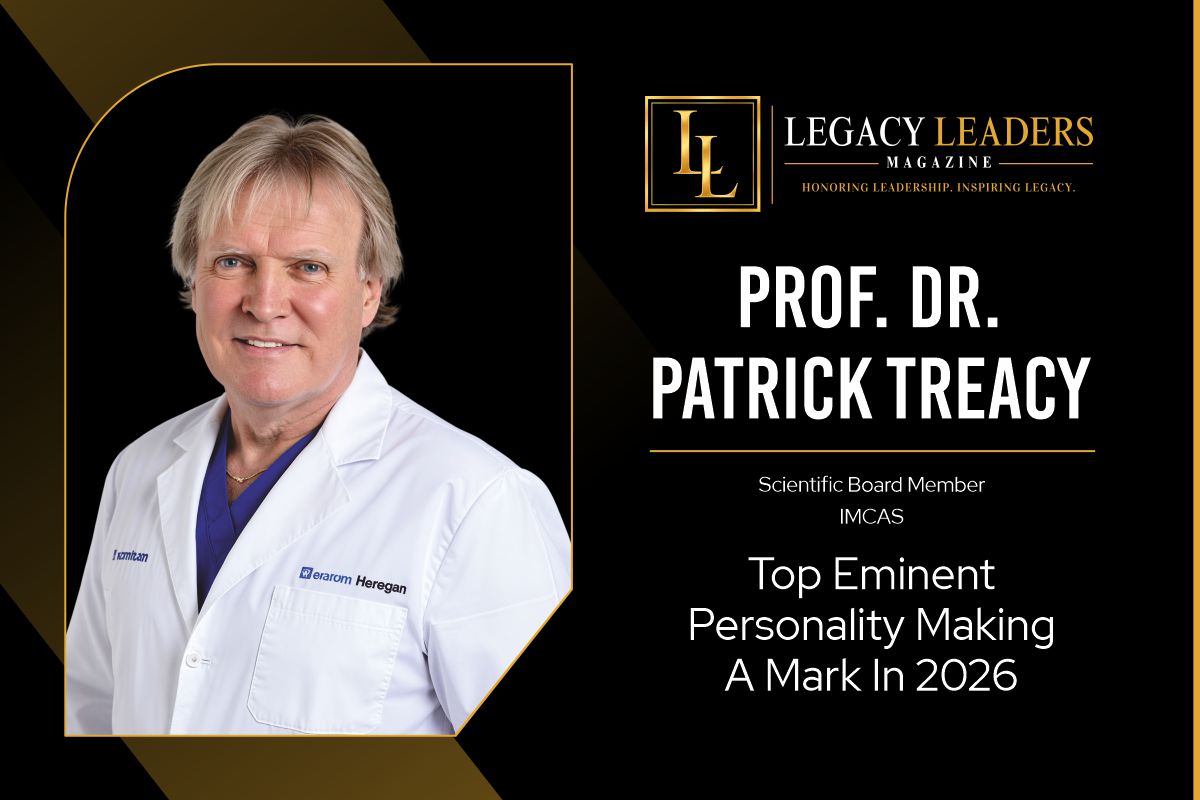
Prof. Dr. Patrick Treacy: Making Aesthetic and Regenerative Medicine Safer Through Experience and Knowledge
“The quality of care depends on the quality of knowledge behind it.”
What happens when experienced medical guidance is missing at the moment it matters most? Patients may face uncertainty, poor decisions, and outcomes that could have been avoided. In dermatology, aesthetic, regenerative, and ageing medicine, the right expertise can make a real difference by bringing together safe treatment, research, education, and honest medical advice.
Prof. Dr. Patrick Treacy, Scientific Board Member at IMCAS, has built a distinguished career around improving patient care, advancing medical knowledge, and helping healthcare professionals make safer and better-informed decisions.
His work spans dermatology, aesthetic and regenerative medicine, research, medical education, and international collaboration, with a strong focus on patient safety and evidence-based care.
Through his work with IMCAS, international teaching, research, books, medical conferences, and humanitarian projects, he continues to share knowledge, address difficult medical challenges, and promote safer approaches to new treatments.
His journey offers a compelling look at how one medical professional can help shape better care, support fellow doctors, and leave a meaningful mark on modern medicine.
A Career Shaped by Curiosity, Experience, and Patient Care
Dr. Patrick’s career has taken him through many different countries, medical settings, and areas of practice, each shaping the way he approaches medicine today. Raised in County Fermanagh, he first studied biochemistry at Queen’s University Belfast before completing his medical training at the Royal College of Surgeons in Ireland.
His early career took him to Ireland, the United States, South Africa, Iraq, New Zealand, and Australia, where he gained experience in rural medicine, skin cancer care, and even worked as a ship’s surgeon. These experiences taught him how to make sound decisions with limited resources, stay calm in difficult situations, and always put the patient first. He later moved into dermatology, laser treatments, and aesthetic medicine at a time when these fields were still developing. His interest in understanding how the body heals and ages gradually led him toward research, teaching, and international medical education. Rather than setting out to become a leader in the field, he focused on finding solutions to medical problems that still needed better answers.
Turning Medical Challenges into Lessons
Some of the most important turning points in Dr. Patrick’s career came from difficult medical situations. His experience in handling serious complications in aesthetic medicine taught him that true leadership is not about always having the right answer, but about knowing how to respond when things go wrong. This led to his work on hyaluronidase rescue protocols and later approaches such as HELPIR, with the aim of helping doctors respond quickly when patients face serious complications. His work in conflict zones and humanitarian settings also strengthened his ability to make careful decisions under pressure while keeping compassion and patient needs at the centre. These experiences shaped his belief that good medicine must be guided by sound judgment, responsibility, strong evidence, and patient welfare rather than status or reputation.
From International Faculty to Scientific Board Member
Dr. Patrick has been associated with IMCAS for many years as an international faculty speaker, scientific contributor, and reviewer. In 2026, he serves on the IMCAS Scientific Board and speaker faculty, while also contributing to scientific and abstract review activities.
He values IMCAS for bringing medical professionals, researchers, and industry experts from different countries together to share ideas, discuss challenges, and learn from one another. For him, its real value goes beyond presenting new developments. It creates a space where experts can openly discuss what works, what does not, and how medical standards can be improved.
Through this international exchange, professionals can:
- Share knowledge and clinical experiences
- Discuss emerging medical challenges
- Question new ideas and available evidence
- Learn from different perspectives
- Explore ways to improve medical standards and patient care
He believes medicine moves forward when knowledge is shared, questioned, and used to improve patient care.
Proud of Helping Doctors Manage Complications
Dr. Patrick is particularly proud of the work he has done to improve patient safety.
His contributions include:
- Hyaluronidase rescue protocols for serious aesthetic treatment complications.
- HELPIR, for threatened or damaged tissue.
- The DUBLiN Lift, combining different treatment methods to support skin health and rejuvenation.
- International education and training, helping thousands of doctors and nurses improve their knowledge and skills.
- Books, lectures, and teaching, sharing knowledge about complications, ageing, and the development of aesthetic medicine.
- Humanitarian work in South Africa, Liberia, Malawi, Uganda, and Haiti.
Education has remained an important part of his career. Through his books, lectures, and teaching, he has shared knowledge with medical professionals across different countries and specialties.
While professional recognition is valued, he considers the greatest achievement to be seeing medical knowledge put into practice to provide safer and better care for patients.
Patient Safety Before Medical Trends
One of the biggest challenges in modern aesthetic and regenerative medicine is the speed at which new treatments can become popular before there is enough evidence to prove that they are safe and effective. Social media and strong marketing can quickly turn promising ideas into widely accepted trends, making it difficult for patients to know what is genuinely supported by science and what is still being explored.
Dr. Patrick believes this is where responsible medical practice becomes especially important.
The industry needs:
- Strong professional training and clear standards
- Better reporting of complications
- Careful patient selection
- Clear communication about what is known and what remains uncertain
- A stronger focus on evidence when assessing new treatments
For Dr. Patrick, acknowledging uncertainty is a sign of good medicine, not a limitation. When the evidence is not strong enough, doctors should be willing to say, “We do not yet know.” This simple principle helps patients make informed decisions and strengthens trust between doctors and the people they care for.
He follows the same evidence-based approach when assessing new treatments. First, he asks whether a treatment makes scientific sense. He then looks for credible evidence that it can actually improve a patient’s symptoms, function, or underlying condition. If the treatment appears promising, it still needs to be introduced carefully, with appropriate patient selection, informed consent, safety planning, and ongoing review.
When evidence is limited or a treatment is still being tested, patients should be told clearly rather than being given unrealistic expectations. For Dr. Patrick, innovation should never come at the expense of patient safety. His guiding principle: Regenerative medicine is where hype tends to outrun evidence fastest — new peptides, exosomes, stem-cell derived treatments — and Dr. Patrick’s rule is simple: a claim should never be stronger than the evidence behind it.
Learning Goes Beyond Simply Adopting the Latest Technique
Continuous education plays an important role in maintaining high standards of medical practice. Medical knowledge continues to change, so doctors need to keep learning and updating their skills. For Dr. Patrick, learning goes beyond simply adopting the latest technique. It includes understanding anatomy, managing complications, following new evidence, and making sound medical decisions. Through platforms such as IMCAS, doctors can learn from experts around the world, exchange different views, and improve the way they approach patient care. For him, the best learning experience is one that provides new knowledge and encourages doctors to ask better questions.
Two Decades of Teaching Doctors to Handle Complications
Working across different countries has taught Dr. Patrick that no single healthcare system has all the answers. Each country has its own strengths, and experiencing different medical settings has helped him understand the value of listening, adapting, and learning from different approaches to patient care.
He also recognises that culture can shape how people view beauty, ageing, doctors, and medical decisions which makes it important to understand each patient and situation before making assumptions. These experiences have strongly influenced his approach to teaching and mentorship. Throughout his career, he has learned from doctors across different medical fields and has made it a priority to pass that knowledge on to the next generation. Teaching has become an important part of his work, and over twenty years, he has reached thousands of doctors and nurses internationally each year through lecturing and workshops, with a particular focus on helping doctors understand how to manage complications, not just perform procedures. He also believes strong professional relationships are built through openness, supporting younger professionals, learning from successes and mistakes, and giving credit where it is due.
His advice to young doctors is simple:
build a strong foundation, understand the basics, learn how to manage challenges, read reliable research, and focus on becoming good at what you do before seeking recognition. For him, a strong career should come first, and reputation should follow.
A Good Leader Shows Up in Hard Times
For Dr. Patrick, leadership means serving others with responsibility. He believes a good leader should set high standards, support people during difficult situations, and create opportunities for others to grow. Curiosity, independence, loyalty, compassion, courage, and kindness have remained important values throughout his career. He also believes that leadership is not about always being right, but about being open to new ideas while staying true to strong principles. In a competitive field like medicine, he values the way people are treated just as much as professional success. This commitment to showing up in hard times extends beyond the clinic: Dr. Patrick continues to give daily assistance, remotely via the internet, to dermatologists in the Dermatology Department at Nasser Hospital in Khan Yunis — one of the last functioning hospitals in the Gaza Strip.
Keeping Pace with a Changing Medical World
Dr. Patrick keeps an open mind about his work and remains willing to change his approach when stronger evidence becomes available. He looks beyond aesthetic medicine and continues to learn from areas such as dermatology, skin cancer, wound healing, and aesthetic and regenerative medicine. This wider view helps him understand how different areas of medicine can connect and lead to better patient care. Teaching also plays an important role in keeping his knowledge current, as explaining complex ideas to other medical professionals encourages him to question his own thinking and keep improving.
The Future of Aesthetic Medicine
Dr. Patrick highlights that the next major shift in medicine is expected to move beyond simply treating visible signs of ageing and focus more on understanding what causes ageing in the body. Greater attention will be given to inflammation, cell health, energy production, tissue repair, and the connection between overall health and skin ageing. New technology is also expected to support diagnosis, treatment planning, medical records, and education, while doctors will continue to play the key role in making decisions.
More advanced devices, improved imaging, and personalised treatments are likely to become more common. New approaches in regenerative medicine also show promise, but they need careful research, proper testing, and clear evidence. The professionals who make the greatest difference will be those who understand the possibilities and the limits of these new developments.
Future Goals
Looking ahead, Dr. Patrick is focused on understanding the connection between aesthetic medicine, regenerative medicine, and healthy ageing. His book, The Pathways of Ageing, explores the science behind ageing and how different processes in the body influence the way people age. He is also working on peptides and long-term inflammation, including his book The Fire That Won’t Go Out. Looking ahead, he plans to focus more on clinical work, writing, international medical education, and research that connects aesthetic care with wider health and ageing. He also hopes to continue his humanitarian work, using his medical experience to support communities where expert care is needed most.
Message for Next Generation Doctors
“Do not build your career around being famous. Build it around being useful.”
This message captures much of Dr. Patrick’s approach to medicine. He believes doctors should understand the science, respect the human body, put patient safety first, and always remain willing to learn.
He encourages medical professionals to welcome new ideas while also asking the right questions before accepting them. When complications arise, he believes they should be used as lessons to improve care rather than something to hide.
Above all, he sees medicine as a profession built on trust, compassion, honesty, and human connection. As treatments and technology continue to change, he believes patients will always need doctors who listen carefully, think clearly, care deeply, and speak the truth.
For him, leaving medicine safer, kinder, and better than he found it is the legacy that truly matters.