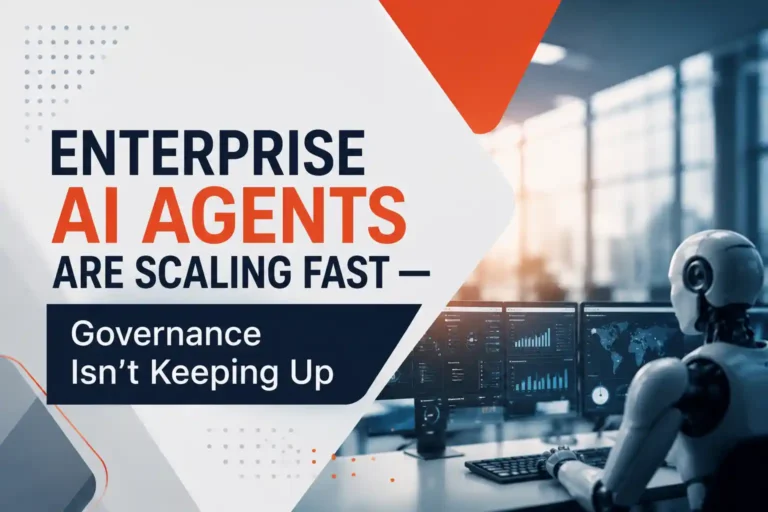
For most of 2025, the conversation around AI agents in the enterprise centered on adoption: how many companies were piloting them, and how quickly. In 2026, that question has been answered — agents are now in production at scale. The harder question leaders face now is whether governance, integration, and value capture can catch up to that pace, or whether the gap between deployment and control keeps widening.
Adoption Has Outpaced Governance
Industry tracking now puts a majority of agent-based AI systems already in production rather than pilot phases, with Gartner forecasting that roughly 40% of enterprise applications will incorporate AI agents by the end of the year. That’s a sharp acceleration from where the technology stood just twelve months ago, when most agent deployments were still confined to narrow, closely supervised experiments.
The risk profile has shifted along with it. When agents were mostly in pilot programs, the biggest danger was falling behind competitors. Now that they’re handling live, multi-step business processes, the bigger risk is deploying them without adequate oversight — what several industry analysts are now calling the “governance gap,” and describing as the new front line of enterprise risk management, alongside cybersecurity.
The Adoption-Value Gap
A separate, related problem has emerged alongside the governance question: a growing split between how many organizations are adopting agentic AI and how many are actually scaling it into measurable value. Recent industry data suggests that while a large majority of enterprises are now adopting agent-based tools, a comparable share are struggling to move beyond pilot-level deployment into full production scale — a gap that’s especially pronounced outside North America, where some regions show the large majority of organizations still piloting rather than industrializing their agent deployments.
The pattern is consistent across multiple studies: high adoption, low value capture. One recent survey of IT leaders found that the overwhelming majority report integration issues as the primary obstacle — not a lack of interest in the technology itself, but an inability to connect agents cleanly into existing systems, data, and workflows.
Why Integration Is the Real Bottleneck
The common thread across this year’s research is that digital transformation isn’t failing because the underlying AI models aren’t capable enough. It’s failing because of architecture and change management — the unglamorous work of organizing data, defining processes, and preparing systems before an agent is ever deployed.
This matters because it reframes where enterprise AI budgets should go next. Analysts tracking 2026 spending patterns note that the smart money is shifting away from funding more pilot projects and toward integration, data infrastructure, and change management — the foundational work that determines whether a successful pilot can actually scale, rather than becoming, in the words of one industry commentator, “a cost with good internal press.”
What This Means for Enterprise Leaders
For CIOs, CTOs, and other technology decision-makers, three questions are now more urgent than “should we adopt AI agents”:
- Who owns agent oversight? As agents move from answering questions to taking actions — issuing refunds, modifying records, executing transactions — accountability for their decisions needs to sit with a specific team, not be assumed as a shared responsibility that ends up belonging to no one.
- Is our data and systems architecture actually ready? The organizations reporting integration failures are, in most cases, discovering that legacy infrastructure built for earlier cloud-first strategies wasn’t designed for the way agents consume and act on data.
- Are we measuring scale-readiness, not just pilot success? A pilot that performs well in a controlled test doesn’t guarantee it will perform well — or safely — once exposed to full production volume and edge cases.
Building a Governance Framework Before Scaling
Enterprises that are successfully closing the adoption-value gap tend to share a few practices in common: they treat agent permissions with the same rigor as employee access controls, they build in human review checkpoints before removing them (not after problems appear), and they measure integration readiness before greenlighting a wider rollout — rather than treating a successful narrow pilot as proof the technology is ready for company-wide deployment.
The story of enterprise AI in 2026 isn’t a story about capability anymore — it’s a story about readiness. Agents are demonstrably capable of handling real business processes at scale; the organizations struggling aren’t struggling with the technology, they’re struggling with the architecture, governance, and change management required to deploy it responsibly. For business leaders, the takeaway is straightforward: the competitive risk this year isn’t being slow to adopt AI agents. It’s adopting them faster than your organization can govern them.