
TSMC Posts Record Profit as AI Chip Demand Outruns Supply
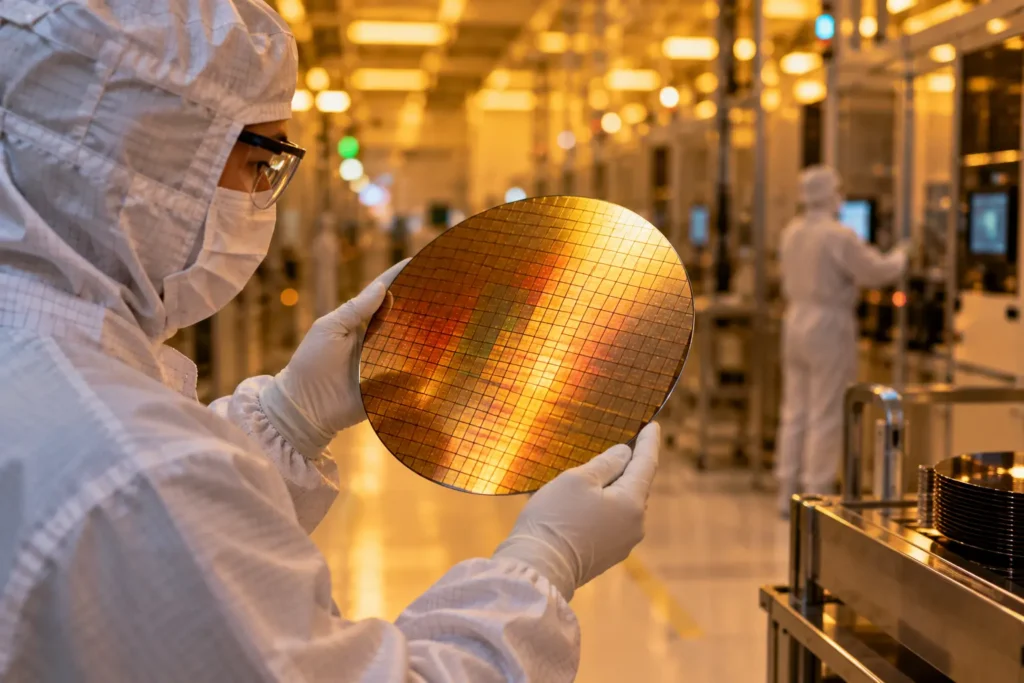
TSMC posted record profit in its third quarter, and demand for AI chips is still running ahead of what it can make. The TSMC Q3 2026 results, released on October 15, showed revenue of NT$1.494 trillion (US$46.72 billion), up 50.9% from a year earlier in Taiwan dollar terms. Net income rose 68.7% to NT$763.06 billion.
Chairman and CEO C.C. Wei said AI demand remains above the company’s current supply capability. For the businesses that depend on TSMC’s factories, which includes nearly every major AI chip designer, that line matters more than the profit figure.
What do the TSMC Q3 2026 results show?
The numbers describe a company running hard at the leading edge. According to TSMC’s earnings release:
- Gross margin reached 66.4%, and operating margin was 58.7%.
- Chips made on 7nm and smaller processes brought in 79% of wafer revenue.
- 3nm led with 33%, followed by 5nm at 28%.
- The newest 2nm process already accounted for 8%.
- Revenue grew 17.6% from the previous quarter.
Diluted earnings per share came in at NT$29.43, or US$4.60 per ADR unit.
Why supply is still the constraint
A 66% gross margin signals pricing power. When demand exceeds supply, the supplier sets the terms. GPU makers and cloud companies designing their own silicon all compete for the same limited leading-edge capacity.
That competition is visible in new chip announcements. Microsoft’s Maia 300 accelerator, unveiled this month, is built on TSMC’s N2P process.
Power is the other limit. Even when chips are available, data centers need grid capacity to run them, a bottleneck we covered in AI Data Center Power Constraints 2026.
What comes next
TSMC guided fourth-quarter revenue of US$52.3 billion to US$54.3 billion, with gross margin of 65% to 67%. That implies another sequential increase, helped by the 2nm ramp. The guidance assumes an exchange rate of 31.8 Taiwan dollars per US dollar.
What It Means for Technology Buyers
Most enterprises never deal with TSMC directly. It sits behind Nvidia, AMD, Apple and the hyperscalers. But tight capacity travels downstream as longer lead times for AI servers, firmer cloud GPU pricing and allocation-based selling.
CIOs planning large AI rollouts for 2027 should treat compute availability as a planning risk, not a given. Secure capacity commitments early. Keep cheaper options in play, such as the small language models that run well on modest hardware. And ask cloud providers how much of their AI capacity depends on third-party GPUs.
For India, the quarter is a reminder of the gap that India Semiconductor Mission 2.0 aims to narrow. Leading-edge manufacturing is still concentrated in very few fabs, and those fabs are setting the pace of the AI economy.