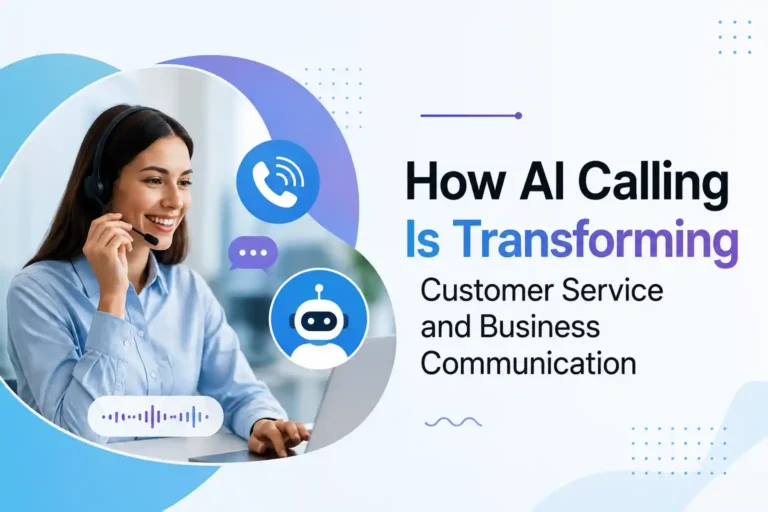
Artificial intelligence is rapidly changing how businesses communicate with customers. AI calling — also known as AI voice automation or AI voice agents — lets organizations answer calls, understand customer requests, and route conversations without needing a human representative for every interaction. From appointment booking to sales lead qualification, AI calling is becoming a standard tool for businesses looking to improve efficiency and customer experience.
What Is AI Calling?
AI calling is a technology that combines artificial intelligence, natural language processing (NLP), speech recognition, and text-to-speech systems to conduct phone conversations with customers. Unlike traditional IVR systems that rely on keypad inputs, AI voice agents understand natural speech and respond conversationally.
Modern AI calling platforms can answer incoming calls, place outbound calls, schedule appointments, collect customer information, provide order updates, and transfer callers to the right department when needed.
How AI Calling Works
An AI calling system typically follows five steps to process a conversation:
- Speech Recognition: The caller’s voice is converted into text using automatic speech recognition technology.
- Intent Detection: The AI analyzes the conversation to understand what the customer wants — whether that’s booking an appointment, checking an order, or speaking with sales.
- Decision Making: Based on the detected intent, the system determines the best response or workflow to follow.
- Response Generation: The AI generates a natural-language response and converts it into speech.
- Smart Call Routing: If human assistance is required, the system transfers the caller to the most relevant department while sharing the full conversation context.
AI Calling vs. Traditional IVR
Traditional IVR systems require callers to navigate rigid menus — “Press 1 for Sales,” “Press 2 for Support.” AI calling replaces that structure with natural conversation, reducing customer frustration and improving first-call resolution rates.
Benefits of AI Calling
- 24/7 customer support
- Faster response times
- Reduced operational costs
- Higher call handling capacity
- Improved lead qualification
- Better customer satisfaction
- Consistent service quality
- Multilingual support
Industries Using AI Calling
- Healthcare — appointment scheduling
- Banking — customer assistance
- E-commerce — order tracking
- Real estate — lead qualification
- Hospitality — reservations
- Education — admission inquiries
- Insurance — policy support
Challenges to Consider
Despite its advantages, AI calling has real limitations. Complex emotional conversations, legal compliance, data privacy, and integration with existing business systems all remain important considerations. Organizations should also make sure customers can easily reach a human representative when they need one.
The Future of AI Calling
As generative AI continues to advance, voice agents are expected to become more accurate, context-aware, and personalized. Future AI calling systems will integrate more deeply with CRM platforms and enterprise workflows, letting organizations automate increasingly complex customer interactions.
AI calling is reshaping customer communication by combining automation with conversational intelligence. Businesses that adopt AI voice technology can improve efficiency, cut costs, and deliver faster support — while freeing human teams to focus on higher-value interactions. As AI capabilities continue to advance, intelligent voice automation is likely to become a standard part of modern customer service.