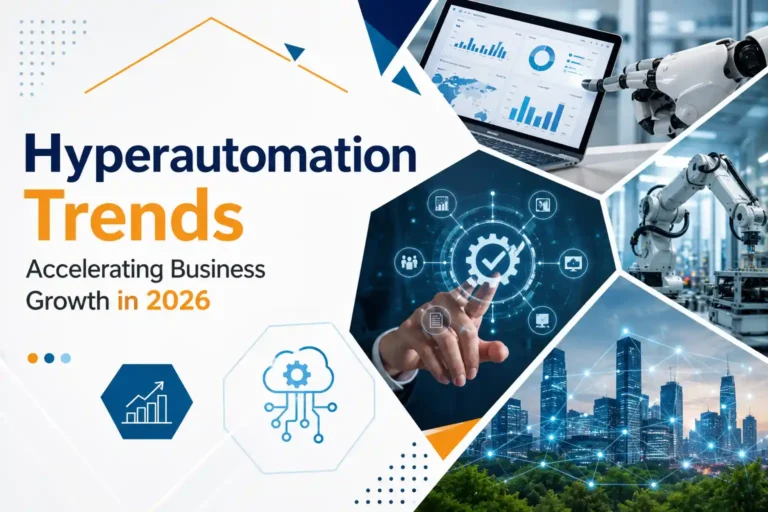
Hyperautomation is rapidly becoming one of the most important business trends in 2026. Organizations are moving beyond basic automation by combining Artificial Intelligence (AI), Robotic Process Automation (RPA), Machine Learning, process mining, and intelligent analytics to automate entire business workflows.
Companies across finance, healthcare, manufacturing, retail, logistics, and customer service are embracing hyperautomation to increase productivity, reduce operational costs, and improve business agility. Rather than automating individual tasks, businesses are creating connected digital ecosystems where processes work together with minimal human intervention.
As competition increases and customer expectations continue to evolve, hyperautomation is helping organizations become faster, smarter, and more efficient.
What Is Hyperautomation?
Hyperautomation is the use of multiple digital technologies to automate complex business processes from start to finish. It combines AI, software robots, intelligent workflows, analytics, and cloud technologies to improve business operations.
Instead of replacing employees, hyperautomation eliminates repetitive work so teams can focus on innovation, strategy, and customer engagement.
Why Businesses Are Investing in Hyperautomation
Organizations are under pressure to improve efficiency while reducing costs. Hyperautomation enables businesses to streamline workflows, minimize manual errors, and deliver faster services.
Companies also gain better visibility into operations through real-time analytics and automated reporting.
Businesses use hyperautomation for:
- Invoice processing
- Customer onboarding
- HR management
- Financial reporting
- Supply chain operations
- IT service management
AI and RPA Work Together
Artificial Intelligence enhances Robotic Process Automation by enabling software robots to make intelligent decisions based on data rather than following fixed rules.
AI-powered automation can understand documents, recognize images, analyze customer requests, and make recommendations while RPA executes repetitive business tasks quickly and accurately.
Technologies powering hyperautomation include:
- Artificial Intelligence
- Robotic Process Automation
- Machine Learning
- Process Mining
- Intelligent Document Processing
- Cloud Computing
- Workflow Automation
- Business Analytics
Industry Adoption Continues to Grow
Hyperautomation is transforming operations across multiple industries.
Manufacturers automate production planning and quality control.
Banks accelerate loan approvals and fraud detection.
Healthcare providers improve patient records and appointment scheduling.
Retailers optimize inventory management and customer support.
Logistics companies streamline warehouse operations and shipment tracking.
Business Benefits
Organizations implementing hyperautomation experience measurable improvements across business functions.
Key benefits include:
- Higher productivity
- Faster workflows
- Reduced operating costs
- Better customer experience
- Improved compliance
- Greater accuracy
- Real-time business insights
- Scalable operations
- Enhanced employee productivity
- Faster decision-making
Challenges Businesses Must Address
Although hyperautomation offers significant value, organizations must prepare for implementation challenges.
Common challenges include:
- Legacy system integration
- Employee upskilling
- Data quality management
- Cybersecurity risks
- Initial investment costs
- Change management
Businesses that develop clear automation strategies and invest in workforce training achieve stronger long-term results.
Future Outlook
Hyperautomation will continue reshaping enterprise operations throughout 2026 and beyond. Advances in Artificial Intelligence, cloud computing, low-code platforms, and intelligent analytics will allow businesses to automate increasingly complex workflows.
Organizations that embrace hyperautomation will improve operational efficiency, strengthen customer experiences, and build more resilient digital enterprises capable of adapting to changing market demands.