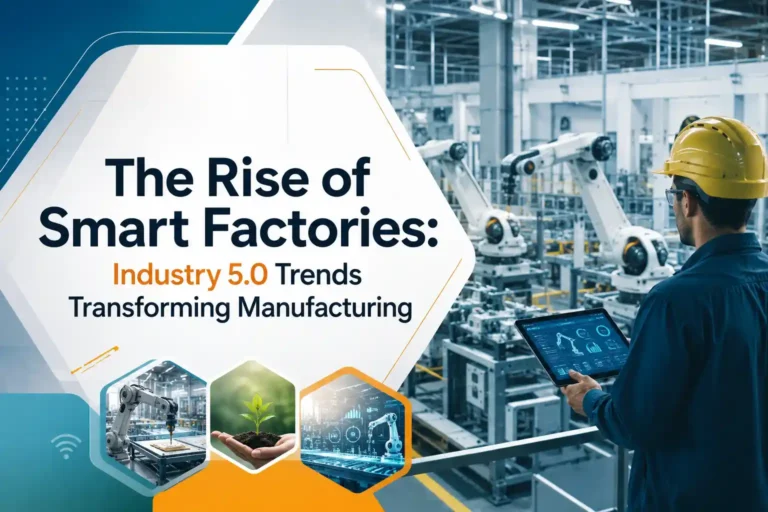
Manufacturing is entering a new era with the rapid adoption of Industry 5.0, where advanced technologies work alongside human expertise to create smarter, safer, and more sustainable production environments. Unlike Industry 4.0, which focused heavily on automation, Industry 5.0 emphasizes collaboration between people and intelligent machines to improve productivity, innovation, and operational resilience.
As manufacturers face increasing demand for customization, faster production cycles, and sustainable operations, smart factories are becoming a strategic investment for businesses worldwide.
What Are Smart Factories?
A smart factory uses connected technologies such as Artificial Intelligence (AI), the Internet of Things (IoT), robotics, cloud computing, and real-time analytics to optimize manufacturing processes. Every machine, sensor, and production system communicates continuously, allowing manufacturers to monitor operations, detect problems, and improve efficiency.
These intelligent facilities help businesses reduce waste, improve quality, and respond quickly to changing customer demands.
Industry 5.0 Puts Humans at the Center
One of the biggest changes in Industry 5.0 is the focus on human-machine collaboration. Instead of replacing workers, businesses are using collaborative robots (cobots) and AI-powered systems to assist employees with repetitive or hazardous tasks.
This approach improves workplace safety while allowing employees to concentrate on creativity, decision-making, and innovation.
Industry 5.0 priorities include:
- Human-centric manufacturing
- Collaborative robotics
- Employee safety
- Sustainable production
- Personalized manufacturing
- Digital innovation
AI and IoT Are Powering Intelligent Production
Artificial intelligence and IoT sensors provide manufacturers with real-time visibility into every stage of production. AI analyzes machine performance, predicts maintenance requirements, and identifies quality issues before they affect production.
IoT devices continuously collect operational data that helps businesses optimize energy consumption, inventory management, and production scheduling.
Smart factory technologies include:
- Artificial Intelligence
- Internet of Things (IoT)
- Industrial robots
- Cloud manufacturing
- Digital twins
- Predictive maintenance
- Edge computing
- Machine learning
Benefits of Smart Factories
Organizations investing in smart manufacturing are seeing measurable business improvements.
Key benefits include:
- Higher production efficiency
- Reduced downtime
- Improved product quality
- Lower operating costs
- Better worker safety
- Faster decision-making
- Sustainable manufacturing
- Real-time monitoring
- Increased flexibility
- Stronger customer satisfaction
Challenges Manufacturers Face
Although smart factories offer significant advantages, businesses must address several challenges before implementation.
Common challenges include:
- High technology investment
- Legacy equipment integration
- Cybersecurity risks
- Skills shortages
- Employee training
- Data management complexity
Successful manufacturers overcome these obstacles by investing in workforce development and adopting phased digital transformation strategies.
The Future of Manufacturing
As Industry 5.0 continues to evolve, smart factories will become essential for organizations seeking long-term competitiveness. Manufacturers that combine advanced technologies with skilled employees will be better positioned to deliver innovative products, improve sustainability, and adapt to rapidly changing market demands.
The future of manufacturing is no longer defined solely by automation. It is driven by intelligent collaboration between people, machines, and data—creating more resilient, efficient, and customer-focused industries.