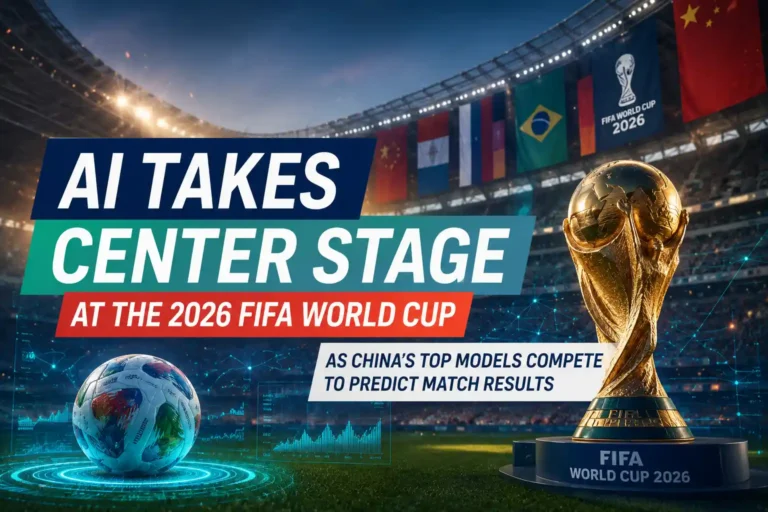
The 2026 FIFA World Cup is becoming more than just the world’s biggest football tournament. Alongside the action on the pitch, China’s leading artificial intelligence models are competing in a nationwide challenge to predict match results, turning the tournament into a real-world test of AI capabilities.
The competition, called the Human vs. AI FIFA World Cup Challenge, was launched by Chinese broadcaster Migu in collaboration with Lenovo, FIFA’s official technology partner. The initiative has attracted millions of participants and combines football, artificial intelligence, and entertainment into a unique fan experience.
China’s Leading AI Models Enter the Competition
The challenge brings together 12 of China’s top large language models (LLMs), including DeepSeek, Kimi, ERNIE Bot, Qwen, Jiutian, and several other AI systems. All participating models operate under the same evaluation framework, allowing their prediction accuracy to be compared throughout the tournament.
Before the World Cup began, each AI model predicted which teams would qualify from the group stage. As the competition progressed into the knockout rounds, the models began forecasting match winners and, in some cases, exact scorelines.
To increase viewer engagement, Migu also introduced a live television program titled “Human vs. AI: Who Predicts It Better?”, where celebrity guests compete against AI models by making their own match predictions. After every game, a live leaderboard ranks both the AI systems and human participants based on prediction accuracy.
Jiutian Leads the AI Leaderboard
Among all participating models, China Mobile’s Jiutian has emerged as the top performer.
As of July 7, Jiutian had achieved a 69% success rate in predicting match outcomes, outperforming several competing AI systems.
The model also demonstrated strong performance in predicting difficult results, including draws and unexpected outcomes. During the tournament, Jiutian correctly predicted a draw between the Netherlands and Japan, accurately forecast Argentina’s 2-0 victory over Austria, and was the only model to predict a 1-1 draw between Belgium and Senegal.
How the AI Models Generate Predictions
While each AI model uses a different approach, most combine multiple data sources before generating predictions.
Models such as Alibaba’s Qwen, Zhipu, and MiniMax rely on multi-agent AI systems that divide analytical tasks across specialized agents. Meanwhile, Kimi reportedly uses hundreds of AI agents to evaluate factors including player fitness, injuries, tactical formations, historical performance, weather conditions, and betting market trends.
By analyzing large volumes of real-time information, these systems attempt to improve prediction accuracy as the tournament progresses.
More Than Entertainment
The Human vs. AI FIFA World Cup Challenge serves as more than a fan engagement campaign. For Chinese AI developers, it provides an opportunity to evaluate their large language models in a public, real-world environment where millions of viewers can compare performance over multiple matches.
Unlike traditional AI benchmarks conducted in controlled testing environments, football predictions involve constantly changing variables, making the tournament an effective demonstration of how AI systems process complex and unpredictable scenarios.
Why It Matters
Artificial intelligence is becoming increasingly integrated into the sports industry, from player performance analysis and tactical planning to broadcasting and fan engagement. The Human vs. AI FIFA World Cup Challenge highlights how AI is expanding beyond business applications into mainstream entertainment while showcasing the rapid development of China’s AI ecosystem.
As AI technology continues to evolve, similar initiatives could become a common feature of major sporting events, offering new ways for fans to engage while providing developers with valuable opportunities to demonstrate the capabilities of their models.