Meta and Sierra Unveil Personal Agent Protocol to Set Rules for AI Agents
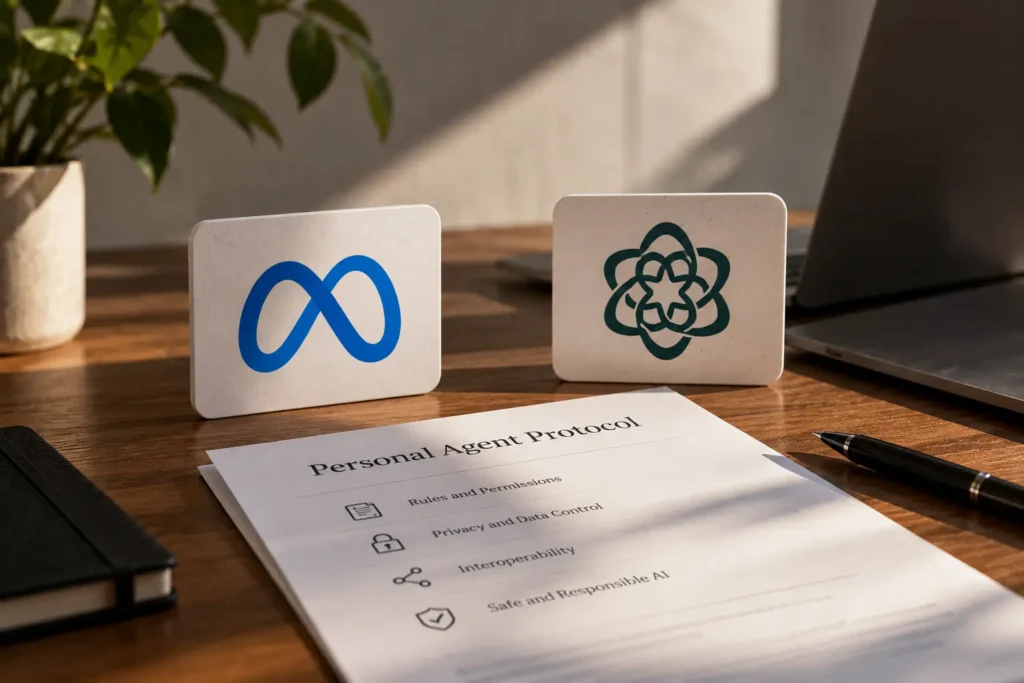
Meta and Sierra announced the Personal Agent Protocol on October 6, 2026. It is an open standard for how personal AI agents sign in, identify themselves and complete tasks with businesses on a customer’s behalf. Genesys, Instinct, Rocket, Shopify, Stripe and Walmart are named as development partners in Sierra’s announcement.
The timing is deliberate. Meta launched its Muse personal agent in September, and agents that shop, book and file claims for users are already reaching company websites. Most of those sites cannot tell a customer’s agent from an anonymous scraper.
How does the Personal Agent Protocol work?
The design splits control between two sides. Customers decide how much access their agent gets. Companies decide what that agent is allowed to do.
A session starts on the company’s website, where the agent finds out what the business offers. It can act as a guest for simple questions, such as checking stock or reading a returns policy. For account tasks, the customer signs in or uses credentials already linked to the agent, and picks read-only or write access.
The session runs on OAuth, a long-established authorization standard. The company then chooses the route. An agent can use its regular web pages, its APIs built on standards such as MCP and OpenAPI, or its own service agent for tasks that need a conversation, like a warranty claim.
Why businesses want a standard now
Agent traffic is growing faster than the rules around it. Amazon has blocked Muse over scraping concerns, Channel Insider reported. Sierra co-founder Bret Taylor has described the current situation as chaotic until a shared standard exists.
The partners frame it as a customer service issue. Stripe’s Kevin Miller said businesses need a consistent way to recognize their customers’ agents and keep shaping those relationships. Shopify’s Mani Fazeli pointed to product questions, purchases, returns and exchanges as early uses.
What is still unproven?
This is a proposal, not an industry standard. Sierra plans to publish the v0.1 specification later this month, run design workshops and release a reference implementation for developers. Payments, finer permissions and push notifications are listed only as possible extensions, with no dates.
Adoption is the real test. OpenAI and Anthropic are not among the named participants. The protocol also enters a crowded field of agent-commerce proposals from payment networks and tech platforms, and no single approach has won yet.
What This Means for Business Leaders
For CIOs and digital commerce heads, the question is not whether to adopt this protocol today. It is whether your systems can recognize and govern agent traffic at all.
Start by finding out how much agent traffic already reaches your site and what it does there. Decide which customer tasks an agent could handle with read-only access, and which need write access or a human check. Then give someone ownership of the v0.1 specification when it lands.
This is the next stage of the shift we tracked in Agentic AI Trends 2026: Beyond the Enterprise Copilot. It also raises the oversight questions covered in The AI Judgment Gap. And if agents become how customers find and buy, being readable to them matters as much as ranking, a point we made in SEO vs AEO.