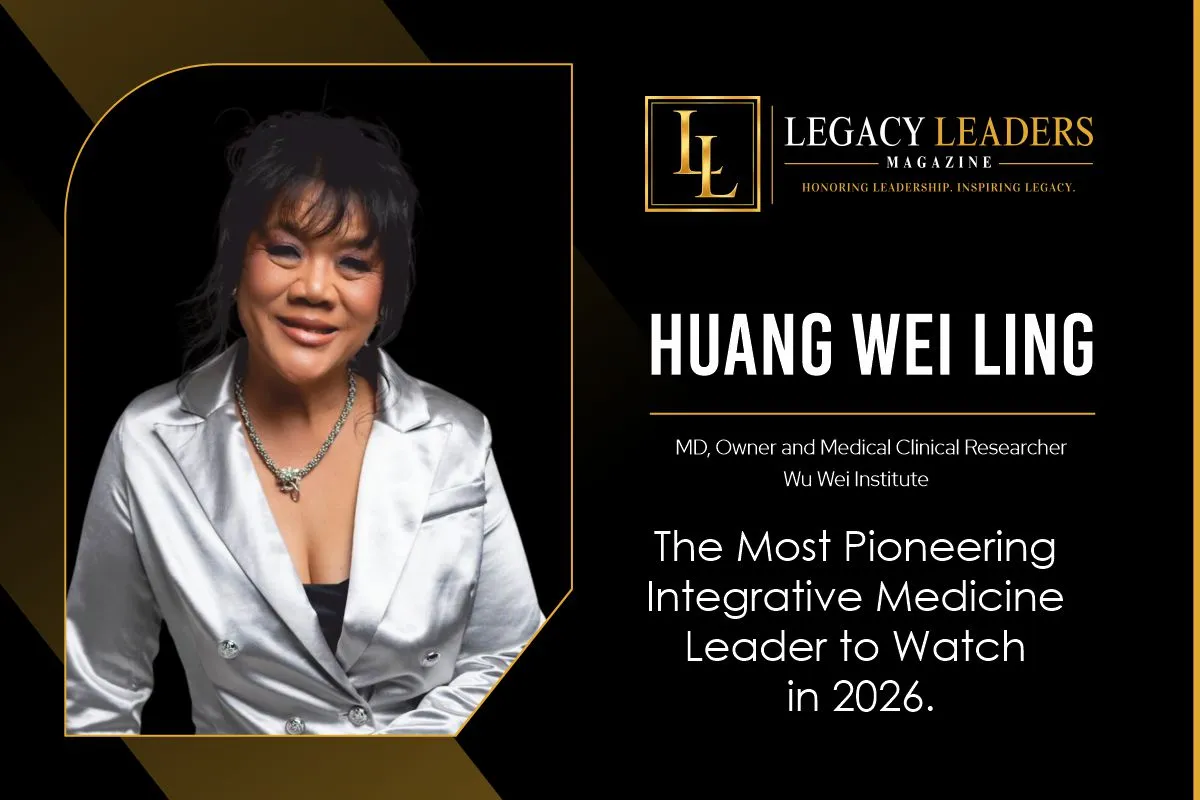
Huang Wei Ling: Making Integrative Medicine More Personal, Research-Focused, and Patient-Centered
Chronic health problems can affect far more than physical health. Persistent pain, fatigue, poor sleep, and other symptoms can gradually interfere with daily activities, emotional well-being, and overall quality of life. Yet many people still struggle to find care that looks beyond individual symptoms and considers the wider factors affecting their health.
This need for a more complete and personalized approach is where Huang Wei Ling, MD, Owner and Medical Clinical Researcher at Wu Wei Institute, has focused her work, studying chronic and complex health conditions through an integrative approach that brings different medical perspectives together.
Her work includes:
- Research: Chronic pain, autoimmune disorders, cardiovascular diseases, ophthalmic conditions, and post-pandemic syndromes.
- Treatment approaches: Traditional Chinese Medicine, medical acupuncture, Chinese dietary practices, and the Wu Wei Protocol.
- Professional responsibilities: Clinical research, treatment development, documentation of clinical outcomes, and medical education.
Under her leadership, the institute has grown from a medical acupuncture and pain management clinic established in 1997 into a center focused on research, education, and integrative healthcare. A key part of this growth has been the development of the Constitutional Homeopathy of the Five Elements Based on Traditional Chinese Medicine, along with continued research into energy-based approaches and personalized care.
Her commitment to documenting clinical work and sharing research has contributed to more than 300 scientific papers and medical conference presentations, helping expand the reach of her work within international healthcare discussions.
Her key professional milestones include:
| Year | Award / Recognition |
|---|---|
| 1998 | Best Research Paper at the Brazilian Hospital Infection Control Congress |
| 2021–2023 | International Scientist Award, received consecutively in India |
| 2025–2026 | Nobel Scientist Award from the Scientific Laurels Committee |
| 2026 | Top Woman Leader in Integrative Medicine and Holistic Healthcare |
| 2026 | Most Visionary Medical Leader of the Year at The Global Icons of Impact Summit, Singapore |
Together, these milestones offer a glimpse into a career focused on expanding how chronic health conditions are researched, understood, and approached, while continuing to promote a more personalized and holistic perspective on healthcare.
From Conventional Medicine to a Broader View of Healthcare
Wei Ling’s medical journey began at the State University of Londrina in Brazil, where she earned her medical degree in 1992 before completing a residency in Infectious and Parasitic Diseases from 1993 to 1995. Early in her career, she worked within conventional medicine and became the coordinator of the Hospital Infection Control Service at the General Hospital of Franca, where she managed antimicrobial prescriptions and hospital protocols. Her commitment to Western medical science was recognized in 1998 when she received the Best Research Paper award at the Brazilian Hospital Infection Control Congress.
Her clinical experience, however, also led her to question how conventional medicine approached chronic and degenerative conditions. While she saw the value of allopathic medicine in treating acute illnesses, she observed that many chronic conditions continued despite long-term medication and could bring unwanted side effects. This experience encouraged her to explore another approach. Born in Taiwan and raised in Brazil, she returned to her cultural roots and began studying Traditional Chinese Medicine and medical acupuncture in 1997 under the guidance of her mother, who had long believed in the future of Traditional Chinese Medicine.
Her experience with Western medicine and Traditional Chinese Medicine shaped her approach to healthcare. She began bringing together the clinical knowledge of Western medicine with the traditional principles of Eastern medicine and the teachings of Hippocrates. This led her to view medical research from a broader perspective, looking beyond biochemistry and individual symptoms to understand the wider factors affecting the human body. It also set the foundation for her work as an independent medical researcher focused on connecting these two approaches and developing a more complete model of healthcare.
Authored Over 300 Peer-Reviewed Papers to Shift Medical Perspectives
One of the biggest challenges throughout Wei Ling research career has been gaining acceptance for an approach that differs from conventional medical thinking. Her work with energy-based medicine, chakra evaluations, and meridian dynamics often faced skepticism from a medical community largely trained in biochemistry and conventional treatment methods. Working as an independent researcher in South America also meant overcoming barriers while building recognition for her work on an international level.
Rather than allowing these challenges to slow her progress, she used them to strengthen her research methods and leadership approach. She recognized that introducing new ideas into medicine requires clear communication and strong evidence. As a result, she placed greater emphasis on carefully documenting clinical outcomes and presenting case studies using established medical terminology. This commitment to detailed research has contributed to more than 300 scientific papers published in international journals and has helped bring wider attention to her work.
These experiences also shaped her approach to leadership and decision-making. She chose to remain independent in her clinical and research decisions, keeping patient welfare at the center of her work rather than allowing outside expectations to determine her direction. Her persistence has since been recognized through several honors, including the International Scientist Award, which she received consecutively from 2021 to 2023 in India, and the Nobel Scientist Award in 2025 and 2026 from the Scientific Laurels Committee. Together, these achievements reflect her continued commitment to independent research and her efforts to bring a different perspective to the way healthcare is understood and practiced.
A Pivotal Moment in Wei Ling’s Career
A pivotal moment in her career came in 1997 while treating a patient with severe, recurring furunculosis that had not responded to several courses of broad-spectrum antibiotics. Despite following conventional treatment, the infections continued to return, leaving the patient and medical team frustrated. Instead of continuing with the same approach, she examined the case through the principles of Traditional Chinese Medicine and considered the condition in terms of an internal imbalance.
She treated the patient with medical acupuncture aimed at addressing what she identified as internal Heat and supporting balance within the meridian system. According to her account, the lesions disappeared within days and did not return. The experience led her to look more closely at the factors behind recurring health problems rather than focusing only on the immediate symptoms. It became an important turning point in her clinical thinking and helped shape the philosophy behind the Wu Wei Institute.
The experience also influenced the development of her treatment methodology, Constitutional Homeopathy of the Five Elements Based on Traditional Chinese Medicine. It reinforced her belief in examining the wider condition of the patient and exploring approaches that address underlying factors alongside physical symptoms. This case became one of the experiences that helped define the direction of her research and her continued work in integrative medicine.
Addressing the Gaps in Conventional Healthcare
One of the key concerns Wei Ling sees in conventional healthcare is its focus on treating individual symptoms and organs rather than looking at the person as a whole. Patients are often referred to different specialists based on their symptoms, with treatment then focused on the affected area. In her view, this can overlook the connection between different parts of the body and the wider factors that may influence a person’s health. She also believes that medical research should look beyond biochemistry and give greater attention to biophysics and the role of energy in the body.
Her approach therefore focuses on looking beyond the physical symptom and exploring what she considers to be its underlying energetic cause. Through clinical research involving thousands of patients, she has studied energy levels within the internal organs and chakra systems and reports finding significant energy depletion in many patients. Based on these observations, her approach places greater emphasis on restoring balance through individualized Chinese dietary practices, medical acupuncture, and Constitutional Homeopathy of the Five Elements Based on Traditional Chinese Medicine, which is also known as the Wu Wei Protocol. Through this work, she aims to offer a more preventive and personalized approach to healthcare that considers the whole person rather than focusing only on individual symptoms.
Advanced Training and Clinical Tools for Integrative Patient Care
The Wu Wei Institute focuses on independent clinical research and medical education in integrative healthcare. Its research covers a range of health conditions, including chronic pain, autoimmune disorders, cardiovascular diseases, ophthalmic conditions, and post-pandemic syndromes. The institute combines traditional pulse and tongue diagnosis with radiesthesia to assess chakra energy levels and understand a patient’s health from a broader perspective.
Key approaches used by the institute include:
- Traditional Chinese Medicine: Uses traditional principles to assess and understand individual health conditions.
- Medical Acupuncture: Used as part of the institute’s approach to individualized patient care.
- Chinese Dietary Practices: Personalized dietary approaches are considered as part of the overall treatment process.
- Wu Wei Protocol: Constitutional Homeopathy of the Five Elements Based on Traditional Chinese Medicine is a central part of her treatment methodology.
- Clinical Research and Education: The institute documents clinical work and shares its findings through research and medical education.
A central part of its work is the Constitutional Homeopathy of the Five Elements Based on Traditional Chinese Medicine, an approach designed to support the balance of the internal organs, including the Liver, Heart, Spleen, Lung, and Kidney. Alongside this, the institute uses medical acupuncture, dietary practices, and other elements of Traditional Chinese Medicine as part of its integrative approach. Through research, clinical work, and education, the institute aims to support patients, provide healthcare professionals with additional approaches to patient care, and encourage wider discussion around integrative medicine. Its research and publications also reflect its broader goal of exploring how traditional medical knowledge and modern clinical practices can be considered together when addressing complex and long-term health conditions.
Patient Safety First in Every Treatment
Bringing different medical approaches together begins with one principle: Primum non nocere, or “first, do no harm.”
Wei Ling, maintains the importance of Western medicine’s diagnostic tools, including laboratory tests, medical imaging, and detailed patient histories, while also considering the broader factors that may influence a person’s health. Her approach combines these medical findings with Traditional Chinese Medicine and other complementary practices to develop a more complete understanding of each patient’s condition.
Patient safety remains central to this approach, with treatments focusing on medical acupuncture, individualized dietary practices, and highly diluted therapies. The aim is to support the body while avoiding unnecessary treatment risks. Success is measured through clinical findings and laboratory results and through improvements in sleep, emotional balance, mental clarity, physical strength, and everyday well-being. By bringing clinical knowledge together with traditional practices, her work seeks to provide care that considers the condition and the person experiencing it.
Identifying Severe Internal Energy Drops Years Before COVID-19
One example of the work’s practical impact comes from research conducted during and after the COVID-19 pandemic. While much of the medical response focused on the virus itself, Wei Ling also examined the condition of patients experiencing COVID-19 and post-pandemic symptoms. Through radiesthesia testing, her research identified what she described as very low energy levels across the chakra system among patients experiencing conditions such as severe fatigue, breathing difficulties, cognitive problems, and widespread pain. According to her research, similar patterns had also been observed from 2014, several years before the pandemic.
Based on these observations, she applied the institute’s approach, combining Constitutional Homeopathy of the Five Elements, medical acupuncture, and Chinese dietary practices to support what she described as the restoration of internal energy. The reported outcomes included improvements in physical strength, cognitive function, and overall clinical condition among patients who had experienced symptoms for extended periods. She has since presented this research at medical conferences internationally, using these cases to explain her broader approach to studying chronic and complex health conditions through an integrative perspective.
Innovation Deepens the Understanding of Traditional Medicine
For Wei Ling, innovation is not about replacing traditional medical knowledge but finding better ways to study, understand, and validate it. She believes advances in areas such as biophysics, quantum mechanics, and bio-electromagnetism are creating new ways to explore principles that Traditional Chinese Medicine has followed for centuries, including Qi, meridians, and chakras. Modern research methods also help her organize, study, and present clinical findings in a way that can be shared with the wider medical community.
She sees technology playing an important role in the future of integrative healthcare, particularly in developing non-invasive tools for diagnosis and treatment. As research into the body’s energy and electromagnetic activity continues, she expects new methods of measuring these signals to become more widely used. At the same time, she believes technology should always support the human side of medicine rather than replace direct clinical observation. For her, the best use of innovation is to help healthcare professionals understand each patient’s individual needs while keeping personal care at the center of treatment.
Preparing for the Next Chapter of Integrative Medicine
Over the next five to ten years, Wei Ling believes integrative medicine will become a more important part of healthcare rather than being seen only as an alternative approach. The growing burden of chronic and autoimmune conditions is increasing the need for care that is more personalized and focused on prevention. Greater attention is also being given to the role of nutrition, environmental factors, and the body’s overall state in maintaining health. These changes are likely to encourage healthcare professionals to look beyond treating individual symptoms and consider the wider needs of each patient.
Wu Wei Institute is preparing for this changing healthcare landscape by building on decades of clinical research and experience. The institute continues to develop its research base, expand international educational initiatives, and share its methods with healthcare professionals. By documenting its clinical work and developing its treatment approaches, it aims to contribute to the growing discussion around personalized and holistic healthcare while preparing the next generation of practitioners to explore broader approaches to patient care.
A Vision for the Future of Medical Research
The long-term vision of Wei Ling for Wu Wei Institute is to become a respected center for medical research and education, with a stronger place for integrative and energy-based approaches in healthcare. The goal is to encourage a broader view of medicine, where conventional healthcare, emerging technologies, research, and traditional knowledge can work together rather than remain separate. This vision also supports a more collaborative approach to healthcare, with medical professionals, researchers, technology, and community-based health systems contributing to how care is developed and delivered.
She also hopes to encourage future medical research to examine the physical, energetic, and spiritual aspects of human health with the same level of attention given to biochemistry. Ultimately, she hopes her work will leave future generations with a stronger belief that medicine should be guided by compassion, ethical responsibility, intellectual courage, and respect for the individual needs of every patient.