
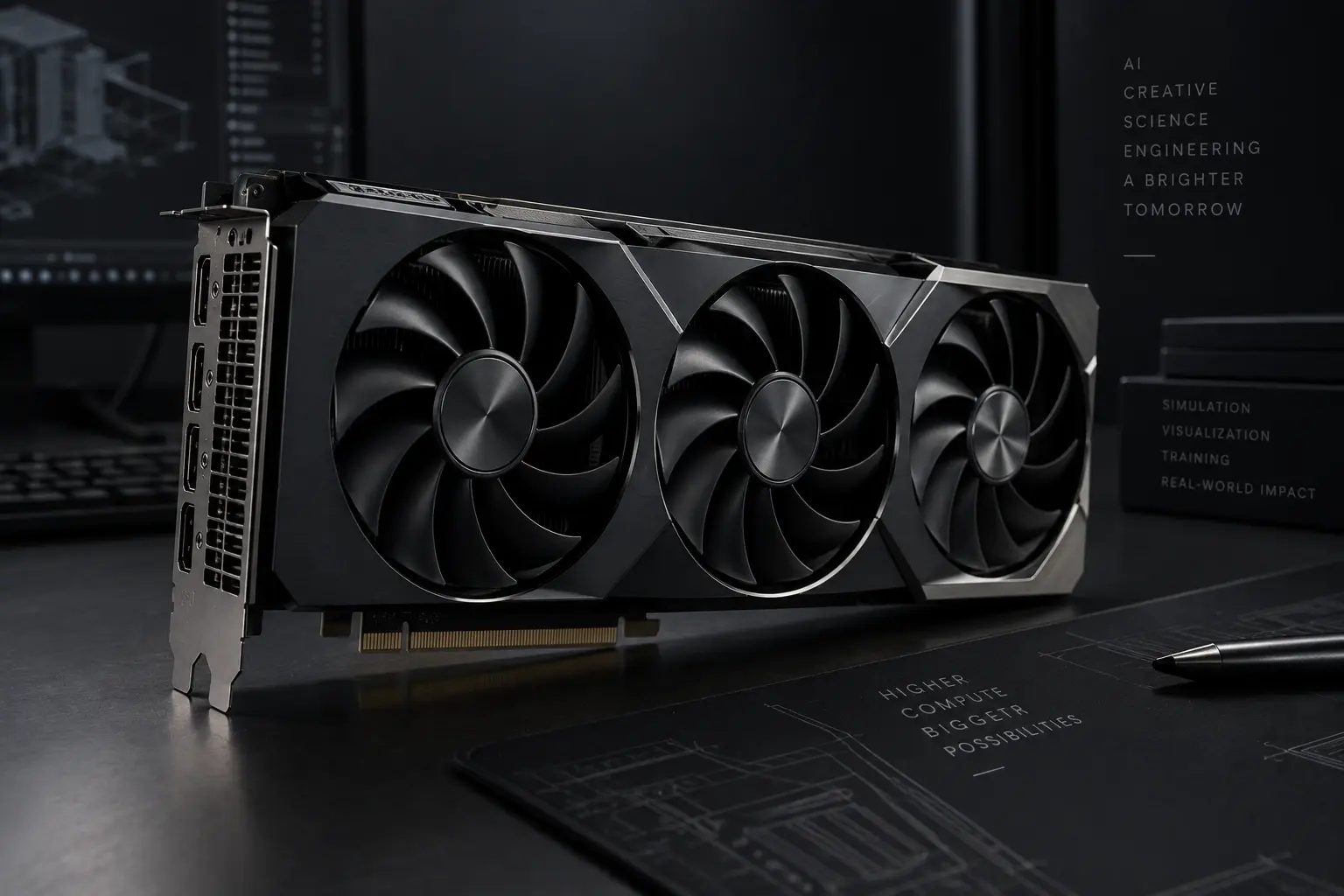
Nvidia’s New RTX PRO 5500 Has Almost the Same Power as Its Flagship GPU — Here’s What That Means
Nvidia didn’t hold a keynote for this one. The company simply added a new card to its professional GPU lineup this week, and the numbers on the spec sheet are doing all the talking.
The RTX PRO 5500 Blackwell Workstation Edition is officially positioned as a mid-tier product — it sits below the RTX PRO 6000 and above the RTX PRO 5000 in Nvidia’s workstation stack. But look at what’s actually under the hood, and “mid-tier” starts to feel like an understatement. This card carries 84GB of memory and a 600-watt power ceiling, numbers that put it within striking distance of Nvidia’s own flagship rather than clearly beneath it.
What’s Actually in the Box
The RTX PRO 5500 is built on the GB202 die, the same silicon found in both the RTX PRO 6000 and the consumer GeForce RTX 5090. It ships with 21,760 CUDA cores — again, identical to the RTX 5090’s core count — but it’s certified for professional workloads and comes with a memory configuration no consumer card touches.
That memory is the headline: 84GB of GDDR7, protected by error-correction code (ECC), spread across 28 individual memory modules soldered to both sides of the board. Nvidia and its partner PNY list the memory bus as 416-bit, delivering roughly 1,398GB/s of bandwidth. According to TechPowerUp’s reporting, that math doesn’t cleanly add up — a 416-bit bus is an unusual width for GDDR7, and the bandwidth figure lines up more neatly with a 448-bit configuration. Nvidia has labeled the specs “preliminary,” so it’s possible the published bus width gets corrected before the card actually ships.
Power draw is the other number that stands out. The RTX PRO 5500 is rated for up to 600 watts — identical to the RTX PRO 6000’s maximum. For comparison, the RTX PRO 5000 one tier down caps out at 300 watts. That’s not a small gap to close.
Why Nvidia Built It This Way
On paper, the RTX PRO 6000 still wins on every core spec: 24,064 CUDA cores versus 21,760, 96GB of memory versus 84GB, and 1,792GB/s of bandwidth versus 1,398GB/s. Roughly speaking, the RTX PRO 5500 trails the flagship by about 10% on cores and 12% on memory capacity.
But those are smaller gaps than you’d expect between a company’s flagship and its next-tier-down card, and that’s likely the point. Nvidia has been pushing hard to get large-memory AI hardware into the hands of teams that don’t need — or can’t justify the cost of — a top-shelf card, while still being able to run demanding local AI workloads: bigger models, longer context windows, or several models running side by side without constantly swapping data in and out of memory. That pressure is part of the same story we covered in AI Data Center Power Constraints 2026 — enterprises looking for ways to run serious AI workloads without depending entirely on hyperscale cloud capacity.
The RTX PRO 5500 also ships with support for Multi-Instance GPU (MIG) technology, which lets a single physical card be logically split into separate, isolated compute instances. In this case, the 84GB card can run as one unified pool or be divided into two 42GB instances that behave like independent GPUs. That’s a meaningful feature for shared infrastructure: instead of one large card sitting idle while a single engineer works on it, a team can split the same hardware across two workloads — say, one engineer fine-tuning a model while another runs inference — without either job stepping on the other’s resources.
Nvidia is clearly building the card for exactly that kind of shared setup. It’s designed for rack-mounted deployment rather than a single desktop tower, and it will ship in both actively air-cooled and liquid-cooled configurations, aimed at organizations that want to centralize GPU power in a server room and distribute access to it across multiple teams.
Where It Fits — and Who Should Care
If you’re an individual creative professional or a small studio, the RTX PRO 5500 likely isn’t the card being built for you — its rack-mount design and shared-instance features are aimed squarely at IT departments provisioning infrastructure for multiple users, not a single workstation on someone’s desk.
The more relevant audience is engineering and IT leads at companies running in-house agentic AI development, robotics simulation work, or large-scale 3D and rendering pipelines who want an alternative to constantly renting cloud GPU capacity. For that buyer, the pitch is straightforward: get most of the memory and power of a flagship card, gain the flexibility to split it across two teams when needed, and presumably pay less than the RTX PRO 6000 costs — though Nvidia hasn’t published pricing for either card as part of this listing.
That’s the biggest open question right now. Nvidia has marked the RTX PRO 5500’s specifications as preliminary and listed the card as “coming soon” with no confirmed release date or price. Until that changes, the real test of whether Nvidia priced this card as a genuine mid-tier option — or positioned it close enough to the flagship that it starts eating into RTX PRO 6000 sales — is still ahead.
Sources: Nvidia product listings; reporting from TechPowerUp, VideoCardz, and Notebookcheck.
Frequently Asked Questions (FAQ)
What is the RTX PRO 5500 Blackwell?
It's a new professional workstation GPU from Nvidia, built on the Blackwell architecture, featuring 84GB of memory and designed for AI, simulation, and rendering workloads in rack-mounted enterprise environments.
How does the RTX PRO 5500 compare to the RTX PRO 6000?
The RTX PRO 6000 has more CUDA cores (24,064 vs. 21,760), more memory (96GB vs. 84GB), and higher memory bandwidth (1,792GB/s vs. 1,398GB/s). Both cards share the same 600-watt maximum power limit.
What is Multi-Instance GPU (MIG) and why does it matter here?
MIG lets a single GPU be partitioned into multiple isolated compute instances. On the RTX PRO 5500, that means the card can operate as one 84GB unit or be split into two separate 42GB instances, letting two workloads run independently on the same physical hardware.
When is the RTX PRO 5500 releasing, and how much will it cost?
Nvidia has not announced pricing or a firm release date. The card is currently listed as "coming soon" on Nvidia's regional product pages, with specifications marked preliminary