Physical AI Enterprise 2026: Robots Are Starting to Reason, Not Just Repeat
For years, warehouse and factory robots followed the same fixed script no matter what showed up in front of them. That’s changing fast. A growing wave of robots and drones can now perceive what’s actually happening around them and adjust in real time, and enterprises are deploying it at a scale that’s hard to ignore.
The term for this is physical AI, and by late 2026 it’s moved well past the conference-stage demo phase. Physical AI refers to systems that combine perception, reasoning, and real-world action: a robot, drone, or piece of industrial equipment that doesn’t just follow a preset path, but actually interprets its surroundings and decides what to do next.
Why Is This Different From Older Automation?
Traditional warehouse automation was built around predictability. A robotic arm picked the same object the same way every time, and anything outside that script needed a human to step in. Physical AI flips that assumption. As one robotics executive put it in recent trade coverage, the goal now is going after the work that was previously almost impossible to automate, because it required human-level perception and judgment, not just repetition.
A concrete example: Doosan Robotics has deployed palletizing robots that use NVIDIA’s Cosmos Reason system to analyze a single camera image of a box, estimate its weight and fragility, and adjust how it’s gripped and placed accordingly. The older version of that robot handled every box the same way regardless of what was actually inside it. The new version decides.
How Big Is This Already?
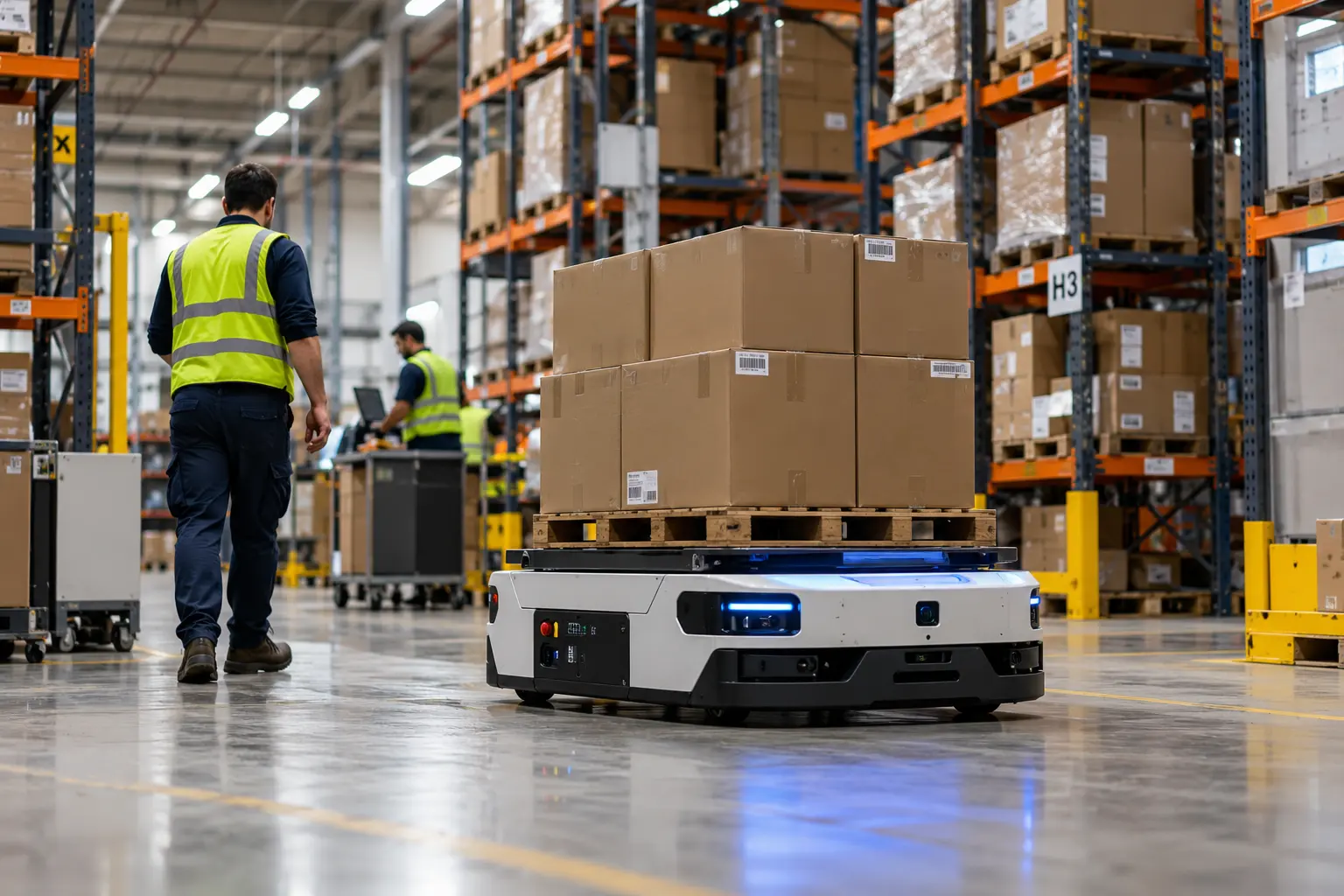
Bigger than most business readers probably realize. Amazon has now crossed one million deployed robots across its global fulfillment network, working alongside human associates on the same warehouse floor rather than in separate robot-only zones. Salesforce has paired its Agentforce platform with NVIDIA’s Cosmos Reason to analyze live video from security robots, reportedly cutting incident resolution time in half. NVIDIA itself now groups the whole category into three buckets: reasoning-focused “agentic” robots, general-purpose humanoid robots, and autonomous vehicles, and treats all three as a single physical AI infrastructure layer it’s building for.
IBM’s own 2026 technology trends report goes further, naming physical AI as a dominant theme for the year precisely because pure language-model scaling has started showing diminishing returns. The next competitive edge, in other words, isn’t a smarter chatbot. It’s a machine that can actually act correctly in a messy, real-world environment.
What’s the Catch?
Mostly infrastructure, and it’s not a small catch. Physical AI needs real-time edge computing close to the machine itself, since a warehouse robot can’t wait on a round-trip to the cloud to decide whether it’s about to collide with something. That pushes the same power and compute questions already facing data centers down onto the factory floor itself.
There’s also a data and governance gap most enterprises haven’t closed yet. A recent Forbes Technology Council piece put it plainly: most enterprise data architecture was built for dashboards and after-the-fact analysis, not for machines making split-second physical decisions in a space shared with people. Sensing, reasoning, and action have to happen in a tight loop, and governance can’t be a one-time compliance review when the system is sharing floor space with human workers every day.
What Should Decision-Makers Take From This?
Physical AI is no longer a research curiosity sitting in a lab demo. It’s operating at genuine scale inside some of the largest logistics and industrial operations in the world, and the infrastructure questions around it, power, edge compute, real-time data pipelines, and ongoing safety validation, are the same infrastructure questions already facing agentic AI software. The difference is that when a software agent gets a decision wrong, someone reviews an output. When a physical robot gets a decision wrong on a warehouse floor shared with people, the same oversight questions apply, except the stakes are measured in more than just a bad report.
Frequently Asked Questions (FAQ)
What is physical AI?
Physical AI refers to AI systems embedded in robots, drones, and industrial equipment that combine perception, reasoning, and real-world action — letting a machine interpret what's actually happening around it and adjust in real time, instead of just following a fixed, preset script.
How is physical AI different from traditional robotics or automation?
Traditional automation follows predefined rules and repeats the same action regardless of what it encounters. Physical AI adds real-time perception and reasoning, so the system can handle variability — like a palletizing robot adjusting its grip based on a box's estimated weight and fragility rather than treating every box the same way.
Which companies are already using physical AI at scale in 2026?
Amazon has deployed over one million robots across its global fulfillment network. Salesforce has paired its Agentforce platform with NVIDIA's Cosmos Reason to analyze live video from security robots. Doosan Robotics uses Cosmos Reason for adaptive palletizing, and NVIDIA groups the category into agentic robots, humanoid robots, and autonomous vehicles as a single infrastructure layer.
What does an enterprise need in place before deploying physical AI?
Real-time edge computing close to the machine, since physical AI can't rely on a round-trip to the cloud for split-second decisions. It also requires a data architecture built for closed-loop sensing and action rather than after-the-fact dashboards, plus ongoing governance and safety validation rather than a one-time compliance review.
Is physical AI only relevant to warehouses and factories?
No. While warehouse and manufacturing robotics are the most visible early use cases, NVIDIA's own framing extends physical AI to autonomous vehicles and transportation as well, and the same infrastructure questions — edge compute, real-time data, governance — apply across any physical environment where machines act alongside people.