Matthew Fornaro: Building a Business Law Practice Around Clarity, Preparation, and Practical Judgment
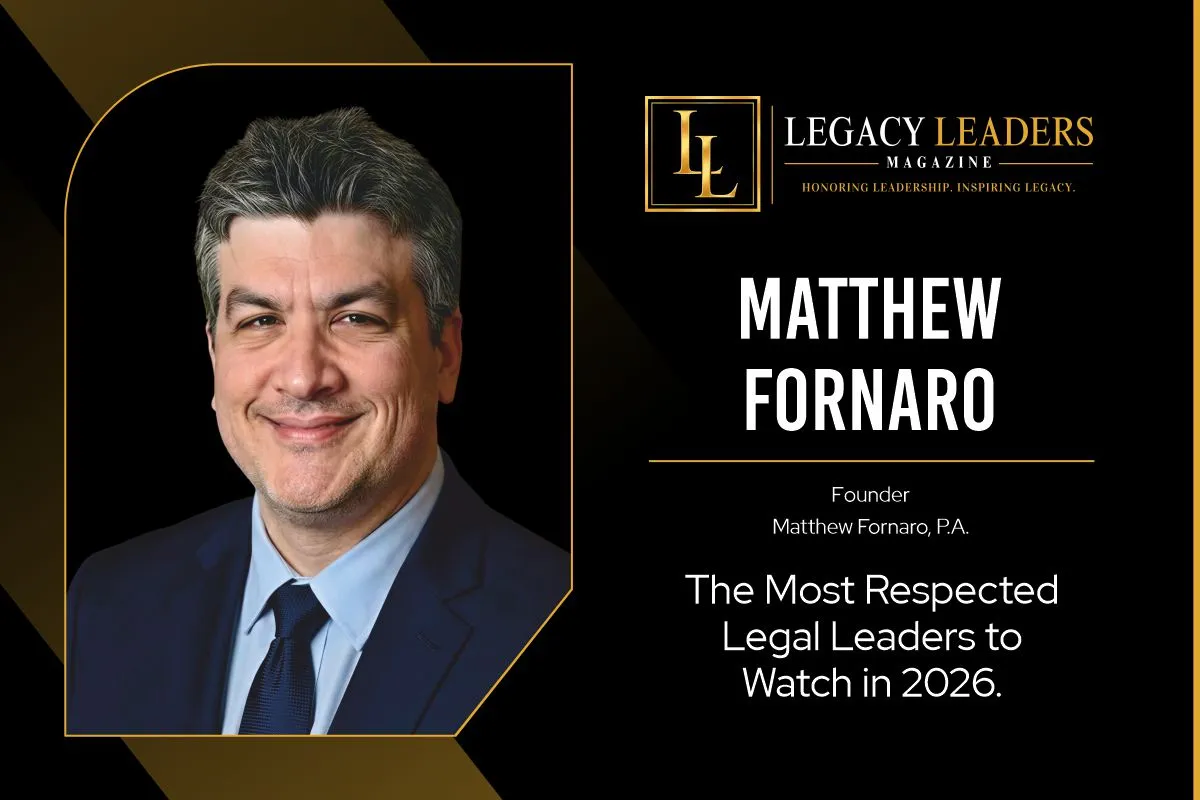
The Coral Springs attorney has practiced since 2003 and founded Matthew Fornaro, P.A. in 2015, building a business-focused practice shaped by litigation experience, entrepreneurship, and a commitment to clear client guidance.
Business owners rarely experience legal problems in neat categories. A contract dispute can involve ownership, intellectual property, money, and a long-standing relationship at the same time. A growth decision can create questions about authority, risk, customer commitments, or who actually controls an important asset. For Matthew Fornaro, that overlap is precisely why business law requires more than knowing what a document says. It requires understanding what the business is trying to accomplish.
Matthew Fornaro, Esq., founder of Matthew Fornaro, P.A., has practiced law since 2003. He founded the Coral Springs firm in 2015 after beginning his career in larger law firm environments, including Greenspoon Marder and Shutts & Bowen. Today, his practice centers on business litigation and transactional business law for entrepreneurs, startups, executives, investors, small and midsize businesses, and established companies.
His work includes business formation, contracts, business transactions, ownership and partner disputes, intellectual property matters, arbitration, mediation, construction litigation, and related commercial disputes. He is admitted to practice in Florida, New York, the District of Columbia, and before the U.S. Supreme Court. His AV Preeminent rating through Martindale-Hubbell reflects peer recognition of legal ability and professional ethics.
A Business Perspective Formed Early
Fornaro’s interest in law began before he fully understood what a legal career involved. As a child, he was fascinated by real disputes and how facts, arguments, rules, and human behavior came together in a decision. He has often traced part of that curiosity to watching The People’s Court and being drawn to the process of resolving disagreement.
Business was equally familiar. His father was a successful small business owner, and watching him operate a company gave Fornaro an early understanding that legal issues are rarely abstract to the person running the business. They affect cash flow, employees, customers, relationships, reputation, and the owner’s ability to move forward.
After graduating from the University of Florida Levin College of Law, Fornaro began practicing in 2003. His early years at larger firms taught him the value of preparation, systems, teamwork, and disciplined litigation strategy. Over time, he saw an opportunity to bring that experience to business owners who wanted sophisticated counsel without the distance or structure of a large firm.
That became the foundation for Matthew Fornaro, P.A. when he established the firm in 2015. The goal was not simply to create a smaller version of a large law office. It was to build a practice in which the lawyer understood both the legal problem and the commercial reality behind it.
Learning the Client’s Side of the Table
Owning a law firm changed Fornaro’s perspective as much as any case did. In a larger firm, many systems already exist. As a business owner, he became responsible not only for the legal work, but also for operations, technology, finances, client relationships, marketing, and long-term planning.
That experience reinforced a lesson he now brings to client matters: the legally safest option is not always the most practical business choice. Owners routinely make decisions with limited time, incomplete information, competing priorities, and real financial consequences. Counsel has to explain the risk clearly enough for the client to make an informed decision rather than simply identifying every possible problem.
The same experience shaped his leadership style. Fornaro emphasizes responsiveness, preparation, direct communication, and accountability. Clients should understand what is happening, what their choices are, and what needs to happen next. The legal issue may be complex, but the advice should not be confusing.
When Growth Outruns the Legal Structure
One of the recurring themes in Fornaro’s work is that successful businesses can create legal risk simply by changing faster than their original structure. A company may add employees, customers, investors, technology, or new markets while continuing to rely on contracts and ownership documents created when the business was much smaller.
That gap can show up in many ways. Founders may rely on informal understandings about ownership. Customer relationships may expand without updated agreements. A key employee may become the only person with access to important information or systems. A company may adopt artificial intelligence tools without first deciding what confidential information employees may share or what customer-facing systems are authorized to say.
Other problems are less dramatic but just as consequential. A renewal deadline goes on nobody’s calendar. An old operating agreement no longer matches how the owners actually run the company. An equity promise exists in an email but not in the governing records. A personal guarantee signed when the company was young remains in place years later. These are all examples of legal infrastructure failing to keep pace with business growth.
Fornaro’s role is to identify those pressure points and connect them to the client’s actual objective. Sometimes the solution is a better agreement or an updated operating document. Sometimes it is a negotiation, a change in internal process, or early intervention in a dispute. When litigation is necessary, the strategy remains focused on what the client ultimately needs the business to accomplish.
A Practice Built Around Business Decisions
Fornaro’s practice is intentionally broad within business law because commercial problems rarely arrive one issue at a time. Contracts may raise intellectual property questions. Ownership disputes may involve compensation, voting rights, capital contributions, or access to company information. A vendor disagreement may become a collection problem or a litigation matter.
His litigation background influences the transactional side of the practice. Having seen agreements fail and relationships deteriorate, he pays close attention to the provisions that matter when the parties no longer agree. Payment terms, termination rights, authority, notice requirements, confidentiality, intellectual property ownership, indemnification, and dispute resolution are not simply boilerplate when the relationship becomes strained.
At the same time, Fornaro resists the idea that every business decision should be driven by fear of litigation. The goal is not to eliminate all risk. Business requires risk. The goal is to understand which risks matter, which can be reduced, and which are commercially acceptable.
Technology Is a Tool, Not a Substitute for Judgment
Technology has become another important part of the practice. Fornaro uses legal technology, including Clio, to help organize and manage the firm efficiently, and he follows developments in artificial intelligence closely.
He sees real value in tools that improve organization, research, drafting, issue spotting, and workflow. He is equally clear that technology does not replace professional judgment. Lawyers remain responsible for verifying work, protecting confidential information, understanding the client’s objectives, and standing behind the final advice.
The same principle applies to businesses adopting AI. Customer-facing systems, public AI tools, automated proposals, and AI-generated content can create issues involving confidentiality, intellectual property, contracts, representations, and authority. For Fornaro, many of these questions are new applications of familiar business-law principles rather than completely new legal problems.
Disputes Require More Than Aggression
Fornaro’s work as a Florida Supreme Court Certified County Mediator, Florida Supreme Court Qualified Arbitrator, and FINRA Dispute Resolution Arbitrator has broadened the way he approaches conflict. Not every disagreement should become a lawsuit, and not every lawsuit should be fought to the last available motion.
Sometimes the best result is a negotiated resolution that protects the business relationship. Sometimes mediation creates a path that direct negotiation could not. Sometimes a demand letter is enough. In other cases, litigation is necessary because the other side will not perform, pay, or negotiate reasonably.
Fornaro believes effectiveness depends on knowing the difference. He does not equate aggression with strength. The stronger strategy is the one that fits the facts, the documents, the leverage, and the client’s objective.
Teaching Keeps the Practice Connected to Entrepreneurs
Teaching and mentoring have remained an important part of Fornaro’s professional life. He is a graduate and instructor of the Kauffman Foundation’s FastTrac NewVenture Program and has worked with the Jim Moran Institute in entrepreneurial education.
Those experiences give him regular exposure to founders before their legal issues become disputes. They also reinforce how quickly business models, technology, and customer expectations change. For a lawyer, that connection is valuable because it keeps legal advice grounded in what owners are actually confronting rather than what a textbook assumes they should be confronting.
A New York and Florida Chapter
Fornaro’s recent admission to the New York Bar represents another stage in the development of the practice. South Florida continues to attract business owners, investors, and professionals with longstanding ties to New York and the Northeast. Many do not leave one market when they enter the other. They operate in both.
For a business owner, that can mean a Florida residence with a New York company, a South Florida operation with northern investors, or contracts and ownership interests that cross state lines. Fornaro’s admissions in Florida and New York allow him to continue developing a practice around those overlapping business relationships while keeping the firm’s South Florida base.
Leadership Through Clarity and Credibility
Fornaro describes his leadership philosophy in practical terms: preparation, responsibility, and clarity. He believes people perform better when they understand the objective and know what is expected of them. He also believes leaders have to make decisions and take responsibility for the outcome.
Integrity is central to that approach. Credibility with clients, opposing counsel, judges, and the business community is built over years and can be damaged quickly. Fornaro tries to be direct without being unnecessarily combative, strategic without losing perspective, and aggressive only when the circumstances justify it.
The same values shape client relationships. Trust is not created by calling oneself a trusted advisor. It comes from being prepared, returning calls, keeping commitments, giving candid advice, and understanding that the legal matter exists inside a larger business.
The Accomplishments That Matter Most
Fornaro values professional recognition, including his AV Preeminent rating, but he does not view any single award or case as the defining accomplishment of his career. He is most proud of building an independent practice that has remained true to its original purpose since 2015 while continuing to evolve with the clients it serves.
His work as a mediator and arbitrator has expanded his understanding of how disputes can be resolved. Teaching entrepreneurs has added another dimension to the practice. His New York admission has opened a new geographic chapter. Together, those milestones reflect the different roles he has occupied during a career that began in 2003: advocate, counselor, business owner, educator, and neutral.
The Next Chapter
Looking ahead, Fornaro wants the firm to grow without losing the direct, practical approach that shaped it. The objective is not to become larger simply for the sake of size. It is to remain useful to entrepreneurs, startups, investors, executives, and established companies that need experienced business counsel and clear next steps.
He also expects writing, teaching, podcasts, and public education to remain an important part of the firm’s growth. Business law continues to evolve alongside artificial intelligence, automation, remote operations, interstate commerce, and new forms of customer interaction. Fornaro wants to keep translating those developments into practical information business owners can use.
The legacy he hopes to build is straightforward. He wants clients to feel they had access to experienced counsel who understood not only the legal issue, but what they were trying to build. He also wants younger lawyers and entrepreneurs to see that professionalism and entrepreneurship are not competing values. A lawyer can take ethics, preparation, and the law seriously while still thinking like a business owner.
Believe, Plan, and Execute
Fornaro’s advice to aspiring attorneys, entrepreneurs, and future business leaders is concise: believe in yourself, have a plan, and execute on it. Ideas matter, but execution is what turns an idea into a business and an intention into a career.
For young lawyers, he emphasizes preparation and credibility. Learn the law, but also learn how businesses operate and how people make decisions under pressure. For entrepreneurs, build the best plan available, act on it, measure what is working, and adjust when circumstances change. Surround yourself with people who know things you do not.
Above all, he believes reputation is an asset that deserves protection. Trust takes time to earn and very little time to lose. In law, business, and leadership, keeping your word and consistently doing what you said you would do remains one of the clearest measures of long-term success.