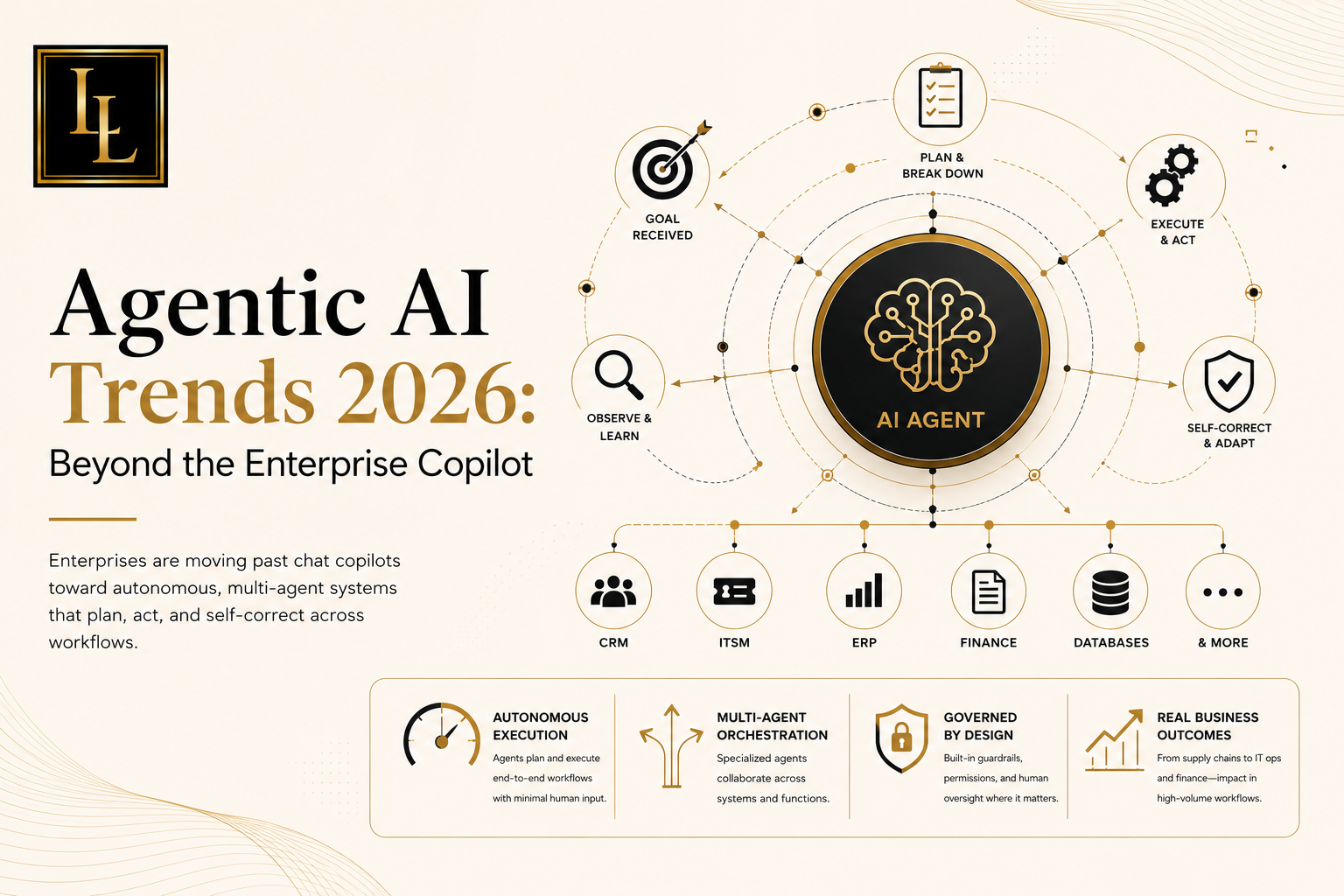
Agentic AI Trends 2026: Beyond the Enterprise Copilot
Autonomous agents that plan, act, and self-correct across business systems are replacing tools that merely suggest — and the gap between who’s experimenting and who’s actually running agents in production is the story enterprise leaders need to understand.
For the past two years, “AI at work” mostly meant a chat window: ask a question, get a draft, copy it somewhere else. That era is ending. Agentic AI trends 2026 point to a different model entirely — systems that take a stated goal, break it into steps, call the tools and APIs needed to execute them, and adjust course when something fails, largely without a human clicking through each stage.
What Actually Changed?
The shift isn’t just better models. It’s plumbing. For an agent to act instead of suggest, it needs a reliable way to reach a company’s actual systems — its CRM, its ticketing tool, its financial software — without a developer hand-wiring a custom connector for each one. The Model Context Protocol (MCP), which Anthropic released as an open standard in late 2024, has become the default answer to that problem. By mid-2026 it had native support from every major AI provider and, per the protocol’s own maintainers, had moved from Anthropic’s project into the vendor-neutral Agentic AI Foundation under the Linux Foundation. A companion protocol, Google’s Agent-to-Agent (A2A), now handles how agents coordinate with each other rather than just with tools. Together, they’ve quietly become the infrastructure layer that makes multi-agent orchestration a production concern instead of a research demo.
How Fast Is Adoption Actually Moving?
This is where the story gets more interesting than the marketing decks suggest. Numbers on agentic AI adoption vary widely depending on who’s asking and what counts as “using” an agent. Gartner’s own 2026 CIO and Technology Executive Survey found that only 17% of organizations have deployed AI agents so far — but more than 60% expect to within two years, which Gartner flags as the steepest adoption curve of any emerging technology it tracks. Other researchers report a similar pattern from a different angle: a large share of enterprises say they’ve adopted agents in some form, but only a small fraction run them in real production workflows rather than pilots. Gartner currently places agentic AI at the “Peak of Inflated Expectations” on its Hype Cycle — a signal that intent is well ahead of operational readiness.
Where deployments are real, they tend to be narrow and high-volume rather than sweeping: supply chain teams using agents to reroute shipments and regenerate purchase orders when a disruption hits, IT operations teams using them to triage incidents and draft remediation pull requests, and financial services firms using them for compliance checks and document assembly that used to take days. Task-specific automation, not general-purpose autonomy, is what’s actually shipping.
The Governance Question Is Arriving Early
Unlike previous automation waves, where governance got bolted on after problems surfaced, agentic AI’s oversight tooling is maturing alongside the technology itself. Gartner’s 2026 Hype Cycle now tracks agentic AI governance, agentic AI security, and cost-management practices as distinct categories in their own right — a sign that enterprises are building in guardrails such as scoped permissions, spending ceilings, and mandatory human sign-off on high-stakes actions before autonomy scales rather than after. That instinct lines up with what we’ve flagged before in the governance gap facing enterprises moving fast on agents.
What This Means for Leaders
The practical takeaway for CIOs and operations leaders isn’t “deploy agents everywhere now.” It’s that the infrastructure question — how agents connect to your systems safely — is largely solved, while the deployment question is still in its early innings almost everywhere. The organizations pulling ahead are the ones treating agentic AI the way they’d treat any other production system: starting with a narrow, well-bounded workflow, instrumenting it for observability, and only expanding scope once the guardrails have been tested under real conditions — not the ones racing to put an agent in front of every process at once.