Google’s Gemini AI Hardware Strategy Takes Center Stage at Pixel 11 Launch
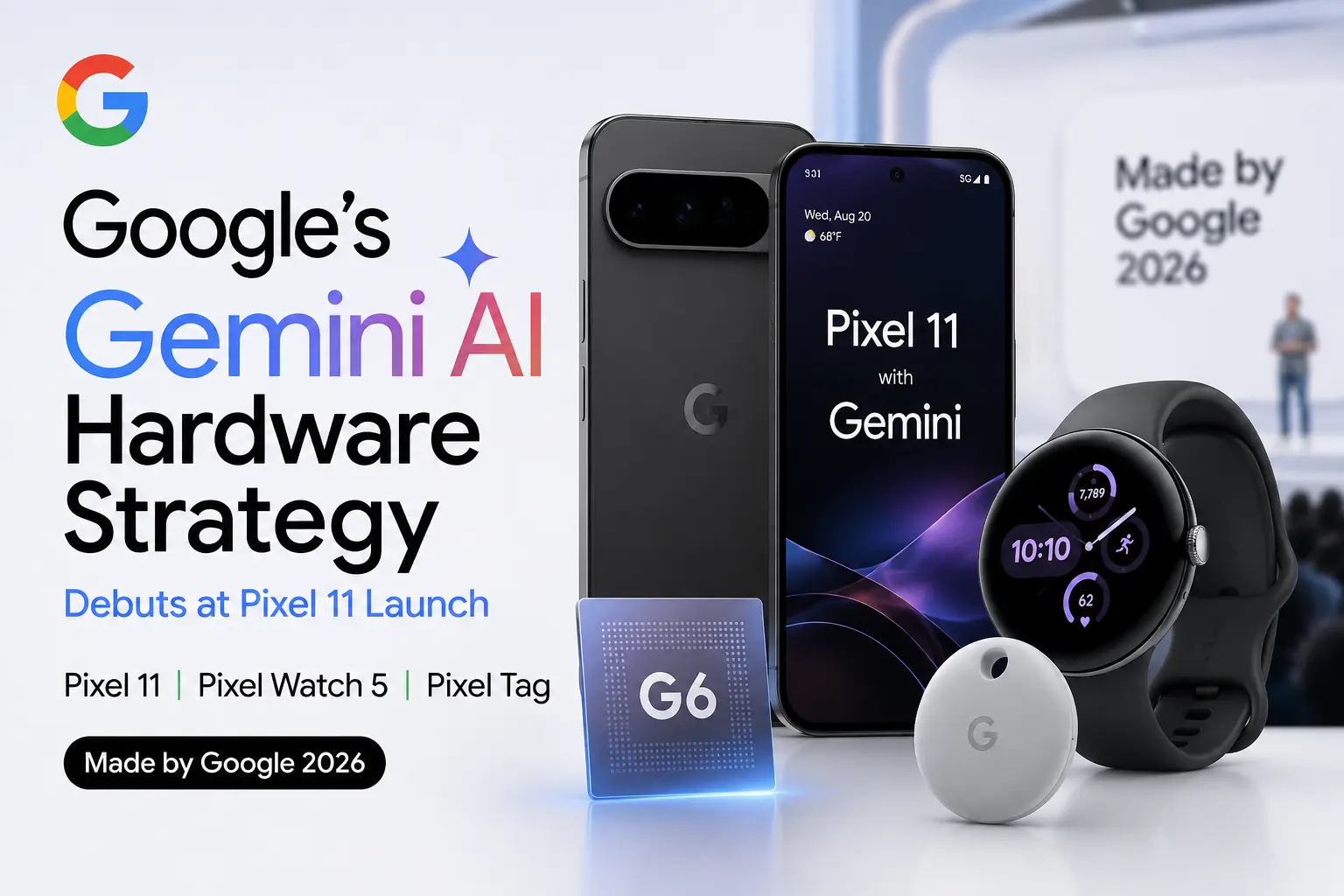
Google’s Gemini AI hardware strategy was the clear throughline at Made by Google 2026, where the company unveiled the Pixel 11 series, Pixel Watch 5, and its first-ever item tracker, the Pixel Tag, at an event held in New York on Wednesday. Rather than leading with chip speed or camera specs, Google positioned Gemini as the primary reason to choose a Pixel over a rival device — a deliberate bet at a moment when Apple and Samsung are both preparing competing hardware cycles of their own.
What Is Google’s Gemini AI Hardware Strategy, Exactly?
Across every device announced Wednesday, Google’s Gemini AI hardware strategy showed up as the featured differentiator rather than a background feature. New Gemini Intelligence capabilities auto-suggest calendar events and wallet passes from context. An updated “At a Glance” tool uses location data to surface loyalty cards and restaurant listings automatically. And last year’s Live Translate feature, powered by the new on-device Tensor G6 chip, now extends to real-time dubbing in podcasts and video apps — not just phone calls.
Pixel 11 Series: Specs Take a Back Seat to AI
The Pixel 11 lineup includes four models — Pixel 11, Pixel 11 Pro, Pixel 11 Pro XL, and Pixel 11 Pro Fold — all built on Google’s new 2nm Tensor G6 chip. The base Pixel 11 starts at $899 and features a camera bar 40% thinner than last year’s, alongside a larger 48-megapixel wide sensor with 56% more light sensitivity. The Pixel 11 Pro Fold tops the range at $1,899, with a redesigned hinge Google markets as significantly more durable than previous foldables. Even so, hardware specs were treated as supporting details in Google’s own presentation — the emphasis stayed on what Gemini enables across the lineup, reinforcing the Google Gemini AI hardware strategy as the event’s real headline.
Pixel Watch 5 and the Pixel Tag
The Pixel Watch 5 starts at $399 ($429 for 45mm models, with a Steph Curry limited edition at $579) and adds a built-in workout builder, closing a long-standing gap with third-party Wear OS apps. The Pixel Tag, Google’s answer to Apple’s AirTag, is priced to match it exactly — $29, or $99 for a four-pack — with a full year of battery life on a replaceable coin cell rather than a sealed unit. It ships November 11.
Why It Matters for Enterprise and Investor Audiences
Google’s event lands weeks ahead of Apple’s expected September hardware cycle and shortly after Samsung’s Galaxy Z Fold 8 and Flip 8 launches, putting three major hardware makers into an overlapping release window this quarter. The more important signal for enterprise and investor audiences isn’t the specs race — it’s that Google’s Gemini AI hardware strategy is now explicit company policy, not an experimental feature layer. That raises the bar every competing device maker needs to clear on-device AI capability to match by the time Apple’s own cycle lands next month, and adds pressure across the consumer electronics supply chain as component demand and freight capacity get contested by multiple launches at once.
Frequently Asked Questions
What is Google's Gemini AI hardware strategy?
It's Google's approach of building its Pixel hardware lineup around Gemini AI as the primary differentiator, rather than competing mainly on chip speed or camera specifications.
When did the Pixel 11 launch?
The Pixel 11 series launched at the Made by Google 2026 event, held in New York on Wednesday, August 12, 2026.
How much does the Pixel Watch 5 cost?
The Pixel Watch 5 starts at $399, with 45mm models starting at $429 and a Steph Curry limited edition priced at $579.
What is the Pixel Tag and when does it release?
The Pixel Tag is Google's first item tracker, priced at $29 (or $99 for a four-pack), comparable to Apple's AirTag. It ships November 11, 2026.