SpaceX Commits Exclusively to Nvidia Chips, Rattling Investors on Its Debut Earnings Call
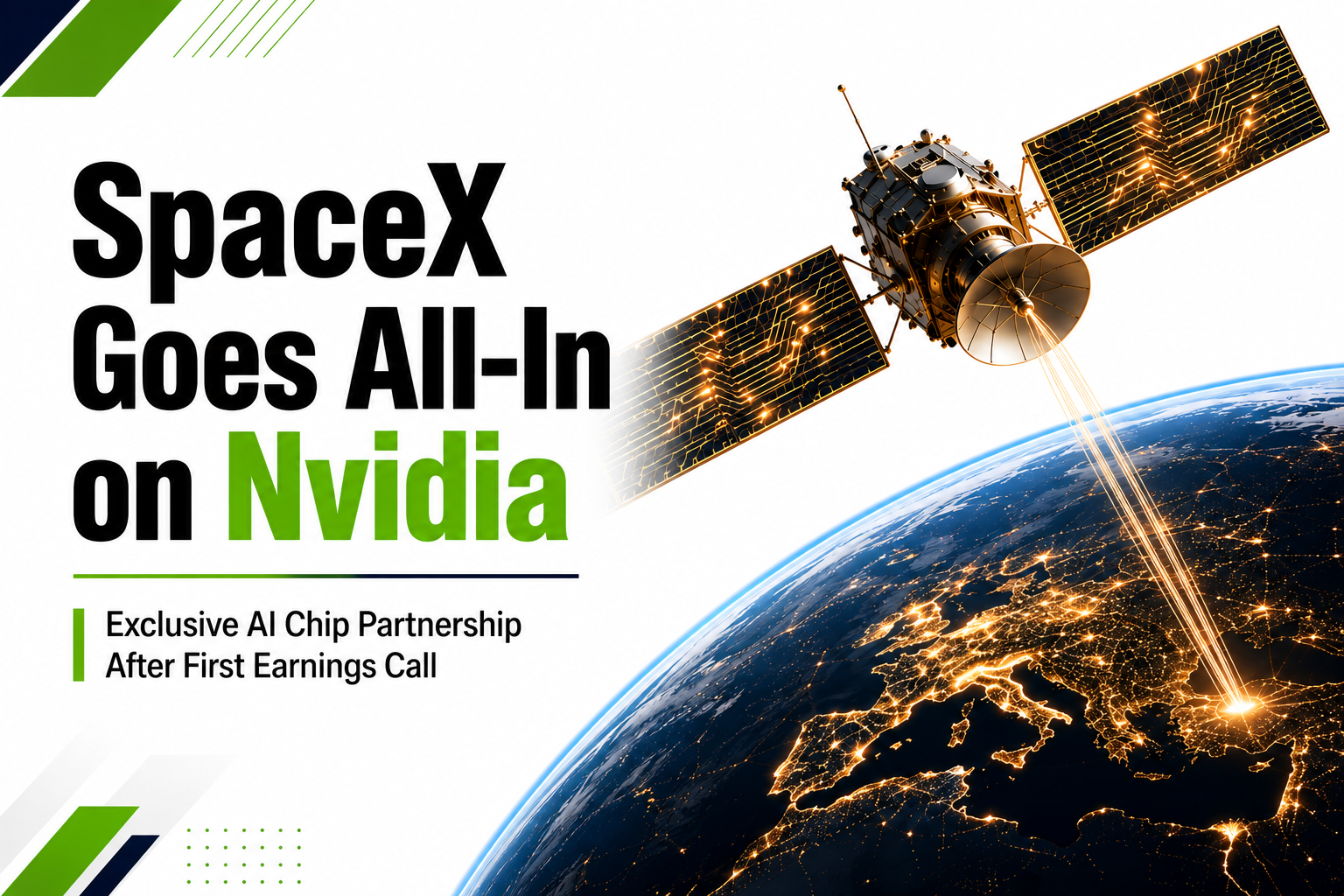
Nvidia shares climbed roughly 2% on Wednesday after Elon Musk told investors that SpaceX will build all of its AI infrastructure exclusively on Nvidia hardware going forward. The comment came during SpaceX’s first-ever earnings call as a newly public company, where Musk framed the decision as a bet on a single architecture rather than a hedge across multiple chip suppliers.
Why Musk Is Betting on One Supplier
Musk told shareholders the company had settled on Nvidia’s Vera Rubin platform as, in his words, the “best AI computer,” and confirmed SpaceX is now “exclusive to Nvidia” for its AI compute needs. That’s a notable commitment at a moment when most major AI infrastructure buyers — from hyperscalers to automakers — have been diversifying chip suppliers rather than narrowing them.
SpaceX also disclosed the scale of what it’s building: the company expects to end 2026 with more than 2 gigawatts of AI compute capacity, scaling toward nearly 10 gigawatts by the end of 2027.
Data Centers in Orbit
Alongside the Nvidia commitment, SpaceX detailed its Starmind program — a planned satellite constellation designed to run AI compute directly in orbit. Each Starmind satellite will carry Nvidia’s Rubin GPUs and Vera CPUs, delivering data-center-class processing power in space rather than on the ground. Musk said the first launches are planned for next year, with the goal of running full-scale Vera Rubin NVL72 rack equivalents off-planet.
The pitch behind orbital compute is straightforward on paper: no land acquisition, and cooling that’s theoretically cheaper in space than on Earth. Whether SpaceX can actually assemble, deploy, and network working data centers in orbit at scale remains the harder, unproven part of the plan.
A Mixed Market Reaction
Investors didn’t treat the announcement as good news across the board. While Nvidia rose on the exclusivity commitment, SpaceX’s own stock fell more than 10% in the aftermath — a reaction tied largely to the scale of AI infrastructure spending revealed alongside the news, even as the company reported that AI-related revenue climbed more than 200% year-over-year, driven by cloud capacity leasing deals with customers including Google and Anthropic.
Why It Matters
For enterprise technology buyers, SpaceX’s move is a signal that single-vendor AI infrastructure bets are back in fashion at the highest levels, even as many CIOs have spent the past two years deliberately avoiding chip-supplier lock-in. It’s also a reminder that “AI infrastructure spending” is no longer just a hyperscaler story — companies with no prior data-center business, from automakers to now aerospace firms, are becoming major compute buyers and, in SpaceX’s case, compute lessors to companies like Google and Anthropic.
For investors, the split market reaction — Nvidia up, SpaceX down on the same news — is a useful reminder that a customer’s massive capital commitment to a chip supplier isn’t automatically bullish for the customer’s own stock, even when it’s clearly bullish for the supplier’s.