
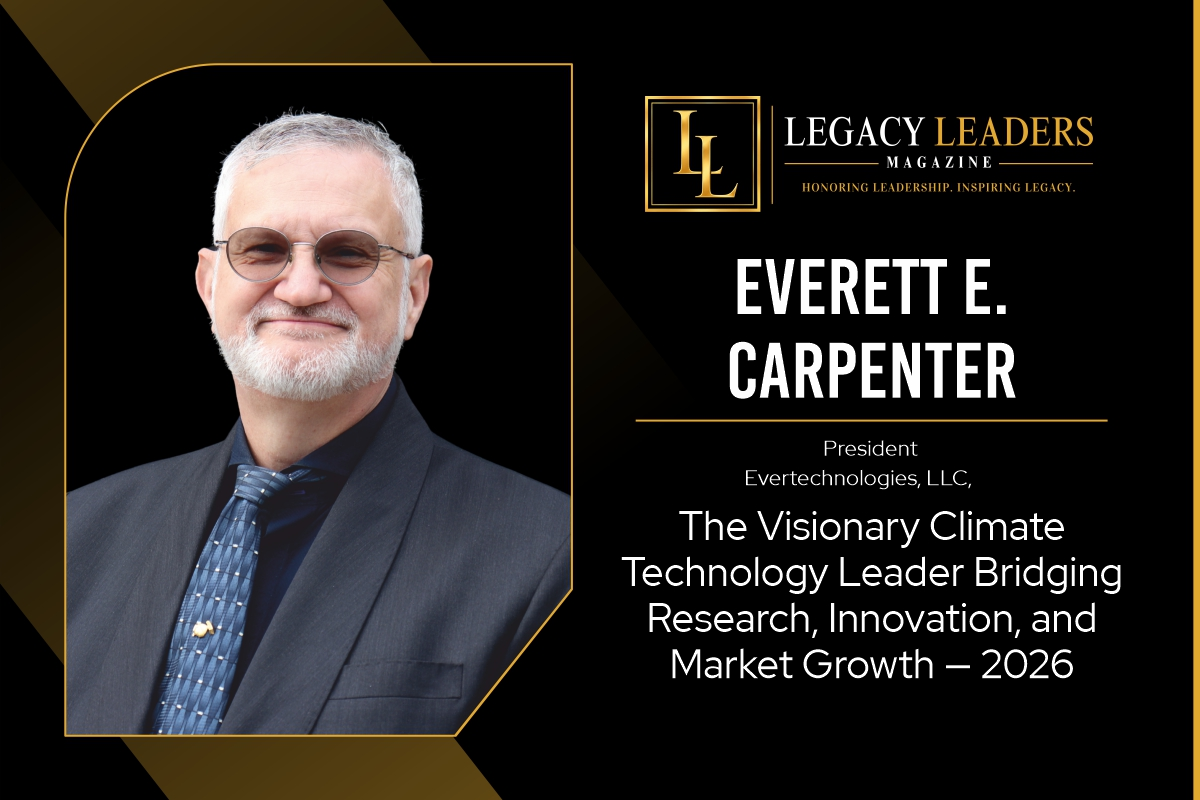
Everett E. Carpenter: Turning Advanced Materials Research into Practical Climate Technologies
Rising energy use, limited resources, and growing environmental concerns are creating a growing need for practical climate solutions. Yet many promising technologies struggle to move from the laboratory to real-world use because of high costs, manufacturing limits, and questions around scalability.
Everett E. Carpenter, Ph.D., MBA, President of Evertechnologies, LLC, works to close this gap by turning scientific research and advanced materials into practical, affordable, and scalable solutions. His work connects research with manufacturing, intellectual property, cost, and market needs, helping technologies move from promising ideas to solutions that can be used in the real world.
Under his leadership, Evertechnologies has focused on making climate technologies more practical and commercially viable. One strong example is his work with environmental-remediation materials, where he helped move a limited batch-manufacturing process toward continuous production while also strengthening the intellectual-property value of the improvements.
His impact extends beyond individual projects, with more than 190 publications, numerous patents, recognition among the top 1% of cited researchers worldwide, and over 30 years of mentoring scientists, engineers, and entrepreneurs. Together, these achievements reflect his ability to connect scientific discovery with practical solutions that can make a lasting difference.
From Materials Science to Climate Action
Everett’s interest in climate technology grew from his decades of work in materials science. He saw how better materials could improve many of the technologies people depend on every day, from motors and energy systems to transportation, refrigeration, and environmental solutions. Over time, his focus moved beyond developing better materials to finding ways they could solve real problems.
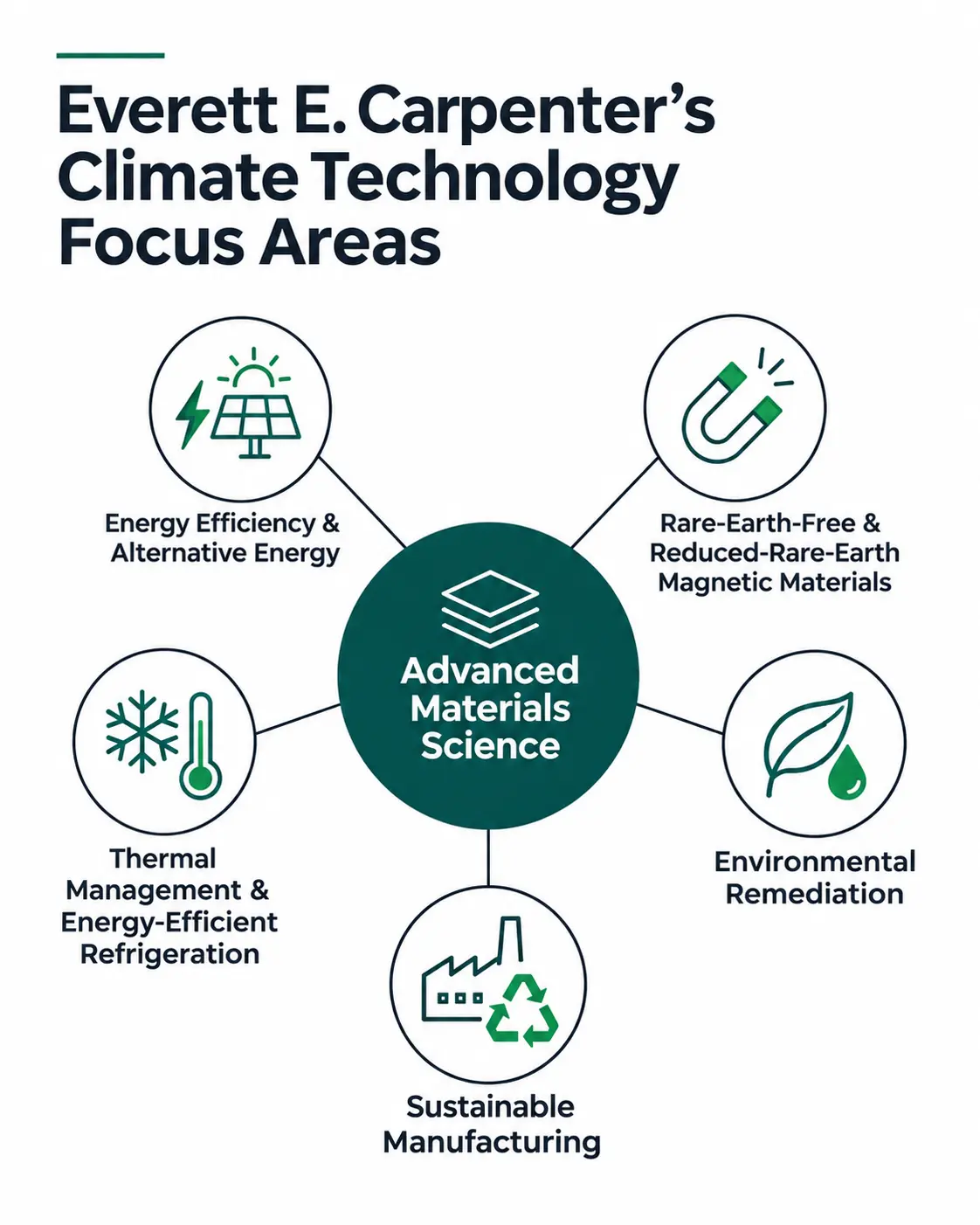
His work has since expanded across several important areas of climate technology, including:
This experience also showed him that a good scientific idea is only the beginning. To create a real impact, a technology must be practical to manufacture, cost-effective, protected through intellectual property, and capable of reaching the market. This understanding led to the creation of Evertechnologies, with a focus on helping promising scientific ideas become practical climate solutions that can be developed, scaled, and used in the real world.
Transitioning Environmental Tech from the Lab to the Market
A defining part of Everett’s work has been showing how scientific ideas can be connected with manufacturing and business strategy to create solutions that are ready for the market. One strong example is his work with advanced materials for environmental remediation. Although the material delivered strong results, its batch-based manufacturing process limited production capacity and made it harder to achieve better economics. By studying the process and identifying the key factors affecting production, he helped develop a path toward continuous manufacturing.The work went beyond improving production. The changes made to the manufacturing process also created new intellectual property opportunities, helping strengthen the technology’s value and competitive position. This project reflects his approach of bringing technology, manufacturing, intellectual property, and business strategy together to help promising innovations become practical and commercially viable solutions.
The Gap Between Laboratory Research and Practical Market Solutions
One of the biggest challenges in climate technology is that a solution that works well in the laboratory is not always practical or affordable to produce at scale. Customers also look at performance, reliability, cost, material availability, and the risks involved in adopting a new technology. These challenges shaped Everett’s practical leadership style, where he looks at the whole system, asks the right questions, tests ideas, and helps teams make informed decisions when the path is uncertain.This thinking also shapes how Evertechnologies approaches the market. Instead of focusing only on scaling a laboratory process, the team starts with the end goal and considers what is needed to meet real customer needs. This means looking at manufacturing, material supply, cost, performance, and ease of adoption together. By taking this approach, Evertechnologies works to develop climate solutions that are simpler, reliable, scalable, and commercially viable, helping promising technologies move closer to real-world use.
Engineering Next-Generation Electric Motors
Everett’s climate-related work combines academic research with the development of technologies that can reach the market. A major focus is developing rare-earth-free and reduced-rare-earth permanent magnets for electric motors, with the aim of creating high-performance alternatives while reducing dependence on limited rare-earth resources. He also explores new iron-nickel magnet structures and materials with strong magnetocaloric effects that could support more energy-efficient refrigeration and reduce the need for conventional refrigerants.Through Evertechnologies, he also works with companies developing advanced materials for energy efficiency, environmental remediation, thermal management, and sustainable manufacturing. His work brings together materials science, research, and practical applications to create technologies that can address real environmental and energy challenges.
Connecting Scientific Research with Real Market Needs
Everett believes researchers and commercial teams should work closely from the early stages of development. Research focuses on what is possible, while commercialization looks at what is useful, affordable, manufacturable, and sustainable. Bringing these perspectives together helps create climate technologies that meet real market needs.He sees commercialization as more than the final step after research. Customer needs, manufacturing challenges, and cost requirements can all help shape better research and lead to more practical solutions. By keeping science and business connected throughout the process, he helps promising ideas move closer to real-world use.
Client’s Success Story
One strong example of Everett’s work is his work with advanced materials developed for environmental remediation. The technology showed strong environmental performance, but its batch-based manufacturing process limited production and made it difficult to achieve better costs. Everett helped identify the key factors affecting the process and develop a path toward continuous production, making the technology more suitable for larger-scale use. He also helped strengthen the intellectual property around these manufacturing improvements, adding value to the technology and its future commercial potential.
The project reflects Everett’s approach of looking beyond whether a technology works in the laboratory. By bringing together material performance, manufacturing, cost, and intellectual property, he helped move the solution closer to practical use. It shows how the right manufacturing approach can help a promising climate technology overcome barriers and deliver greater value in the real world.
AI and Data to Make Smarter Manufacturing Decisions
Everett views AI, advanced analytics, and automation as useful tools for making better and faster decisions. In advanced manufacturing, these tools can help teams understand how production conditions affect material structure, performance, quality, and cost. This is especially valuable when even small changes in the manufacturing process can change the properties of a material. By finding patterns in large amounts of data and improving production consistency, these technologies can support better scientific and engineering decisions without replacing human knowledge and judgment.
The Power of Next-Generation Energy-Efficient Systems
Everett highlights that energy efficiency, resource security, and manufacturability will be among the key factors shaping climate technology over the next five to ten years. He points to the growing need for technologies that can reduce energy use across buildings, transportation, industrial processes, cooling, and electrical systems, helping lower energy demand and its wider environmental impact. He also sees resource security becoming more important as industries look for ways to reduce their dependence on limited and geographically concentrated materials through alternative materials, recycling, and resource-efficient technologies.
Everett also believes that the ability to manufacture a technology at the right cost and scale will be just as important as its performance in the laboratory. A promising invention may struggle to reach the market if it is too expensive, difficult to produce, unreliable, or dependent on uncertain supply chains. For this reason, he expects the climate technologies that succeed will be those that can bring together strong performance, affordable costs, reliable production, sufficient scale, and secure supply, making them practical for wider adoption.
Modular Manufacturing & Strategic Alliances
Everett has developed a practical approach to manufacturing that focuses on lower costs, flexibility, and gradual expansion. Instead of making large investments at the beginning, he supports smaller, modular manufacturing systems that can be improved and expanded as demand grows. This helps climate technology companies manage costs, test the market, and increase production when the need is clear.He also builds strategic partnerships with universities, government laboratories, agencies, startups, and major industrial organizations. These partnerships bring together different skills, resources, technical knowledge, and market experience, giving climate technology projects a stronger foundation for development and growth.
Everett’s Philosophy on Empowering Teams
Earlier in his career, Everett measured success by his ability to solve the problem in front of him. With experience, his view of leadership changed from solving problems himself to creating the right conditions for others to solve them effectively. He believes a strong leader should provide clarity when situations are uncertain, rely on evidence when making decisions, and build an environment based on trust and open communication. He also encourages people to question assumptions, including his own, and to share important information early, even when it may be difficult to hear.
His leadership is also shaped by a strong belief in continuous learning. He sees every research project, success, failure, colleague, and new challenge as an opportunity to gain another useful perspective or skill. Rather than expecting one person to have all the answers, he focuses on helping people learn, think independently, and develop their own ability to solve problems. For him, effective leadership is not simply about achieving results today, but about helping others become better at creating those results tomorrow.
Encourage Open Discussions with Team Members
Everett fosters innovation by bringing together people with different skills, experiences, and ways of thinking. He believes that when everyone looks at a problem from the same point of view, good ideas can easily be missed. To avoid this, he encourages open discussions where team members can share their opinions, question assumptions, and disagree with an idea without making it personal. This creates an environment where people feel comfortable speaking up and exploring new approaches.He also places strong importance on collaboration and continuous learning. Since climate technology brings together science, engineering, manufacturing, economics, policy, and human behaviour, he believes no single person can know everything. Instead, he encourages people to learn from one another, respect each other’s expertise, and work across different areas of knowledge. This approach helps create teams where people can contribute their strengths, continue developing their skills, and work together to find practical solutions to complex challenges.
Industrial & Enterprise Connections
Strategic partnerships have played an important role in strengthening Everett’s work and expanding its impact. Throughout his career, he has collaborated with federal agencies, universities, government laboratories, industrial companies, and entrepreneurial organizations, including DOE, ARPA-E, NSF, DARPA, BASF, Lockheed Martin, and Rogers Corporation. These relationships have provided technical expertise, market knowledge, manufacturing support, customer access, and valuable industry perspectives. By bringing different strengths together around shared challenges, these partnerships have helped strengthen the credibility of his work and support the development of practical climate solutions.
Ranking Among the Top 1% of Most-Cited Global Researchers
Looking back, Everett is most proud of achievements that combine scientific discovery with lasting impact. His work in advanced materials has contributed to more than 190 publications, numerous patents, and international recognition, including being ranked among the top 1% of cited researchers worldwide.
Key milestones in Everett’s career include:
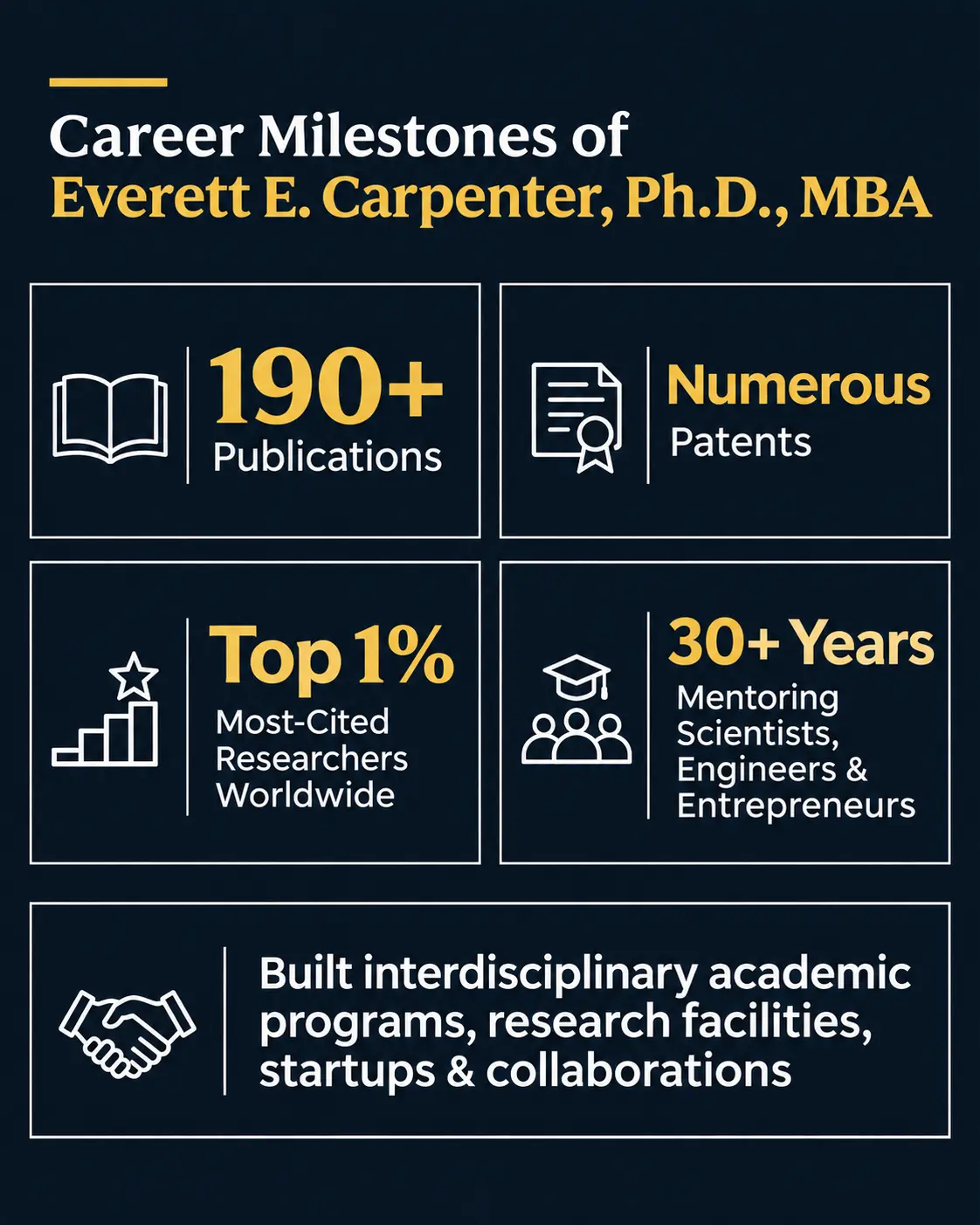
- 190+ publications
- Numerous patents
- Recognition among the top 1% of cited researchers worldwide
- 30+ years of mentoring students, researchers, scientists, engineers, and entrepreneurs
- Contributions to interdisciplinary academic programs, research facilities, startups, and collaborations
He has also helped build interdisciplinary academic programs, research facilities, startups, and collaborations that continued to grow beyond his direct involvement.
Yet, the accomplishment he values most is the people he has mentored. For more than 30 years, he has guided students, researchers, scientists, engineers, and entrepreneurs, many of whom have gone on to build careers, companies, research programs, and new innovations.
Seeing their growth and success, he believes, has created a lasting impact greater than anything he could accomplish alone.
Long-Term Vision
Everett’s long-term vision for EverTechnologies is to help promising climate technologies move from research to practical, scalable, and financially sustainable solutions. He aims to develop technologies that are good for the environment and can be manufactured, brought to market, and adopted on a wider scale.
Beyond the company, he hopes to leave a lasting educational legacy by helping future scientists and engineers think beyond their individual fields. He wants them to understand how strong scientific research can be connected with manufacturing, business, and real-world needs so that important discoveries can become meaningful solutions.
Advice for Future Climate Technology Leaders
Everett advises future climate technology leaders to start with the problem, not the technology. He encourages them to understand their field deeply while also considering how a solution will be manufactured, financed, regulated, purchased, installed, and used. He believes climate challenges cannot be solved through science or business alone; they require people who can connect different fields and understand the bigger picture. He also urges future leaders to keep learning, stay curious, and use their knowledge to find practical solutions that can make a real difference.