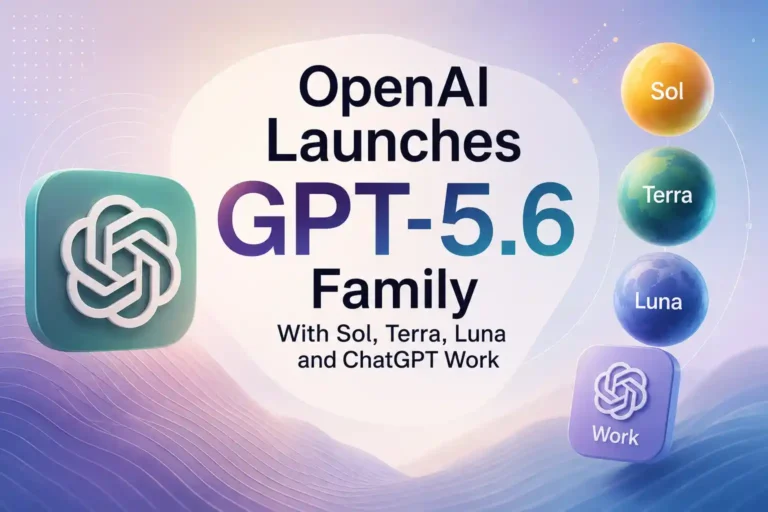
OpenAI has officially introduced GPT-5.6, its latest family of artificial intelligence models, expanding its enterprise AI portfolio with three new variants named Sol, Terra, and Luna. Alongside the new models, the company also announced ChatGPT Work, a productivity platform designed to support businesses with everyday workplace tasks.
The launch comes as competition within the AI industry continues to accelerate, with technology companies racing to deliver more capable, efficient, and cost-effective models for enterprise customers and developers.
Three Models Designed for Different Workloads
The GPT-5.6 family consists of three models tailored to different performance and pricing requirements.
Sol serves as the flagship model, targeting demanding enterprise applications, software development, scientific research, and complex reasoning tasks. Terra is positioned as a balanced option that combines strong performance with lower operating costs, while Luna is designed as the most affordable model for organizations looking to deploy AI at scale.
According to OpenAI, the new model family offers significant improvements in efficiency compared with previous generations. CEO Sam Altman recently stated that Sol is approximately 54% more token efficient for coding-related tasks, helping reduce computational costs while maintaining high performance.
Cybersecurity Capabilities Expanded
OpenAI describes GPT-5.6 as its most advanced cybersecurity-focused model to date.
The company says the models are designed to assist organizations with defensive cybersecurity activities, including threat modeling, secure code reviews, vulnerability patching, and blue team simulations that help identify weaknesses before they can be exploited.
The cybersecurity capabilities have attracted significant industry attention, with previous discussions around advanced AI models focusing on both their defensive potential and the need for responsible deployment.
ChatGPT Work Targets Enterprise Productivity
In addition to GPT-5.6, OpenAI introduced ChatGPT Work, a new AI-powered productivity platform built specifically for enterprise users.
Available across desktop, web, and mobile, ChatGPT Work is designed to help professionals complete common workplace tasks such as drafting documents, preparing spreadsheets, creating presentations, and supporting day-to-day business workflows.
The launch reflects OpenAI’s continued expansion into enterprise productivity software as organizations increasingly integrate generative AI into daily operations.
OpenAI Highlights Coding Performance
OpenAI also emphasized improvements in software development capabilities across the GPT-5.6 family.
Using results from the Artificial Analysis Coding Agent Index, the company says Sol achieved higher coding benchmark scores than competing models while using fewer output tokens, completing tasks more quickly, and operating at a lower cost.
OpenAI also claims that Terra performs competitively against Anthropic’s Fable 5 model, while Luna outperforms Anthropic’s Opus 4.8 in the company’s reported benchmark comparisons. These benchmark results are based on OpenAI’s published performance data.
Pricing and Availability
The GPT-5.6 family is now available through ChatGPT, Codex, and the OpenAI API.
OpenAI has announced the following API pricing per one million tokens:
- Sol: $5 input / $30 output
- Terra: $2.50 input / $15 output
- Luna: $1 input / $6 output
The tiered pricing structure allows developers and businesses to choose a model based on performance requirements and operating costs.
Why It Matters
The introduction of GPT-5.6 signals OpenAI’s continued focus on enterprise AI adoption. Beyond improving conversational capabilities, the new model family emphasizes software development, cybersecurity, workplace productivity, and cost efficiency, areas that have become increasingly important as businesses deploy AI across their operations.
The launch also intensifies competition among major AI companies as enterprise customers evaluate models based not only on intelligence, but also on pricing, reliability, security, and real-world productivity.
As organizations continue integrating generative AI into everyday workflows, GPT-5.6 positions OpenAI to strengthen its presence in the rapidly expanding enterprise AI market.